





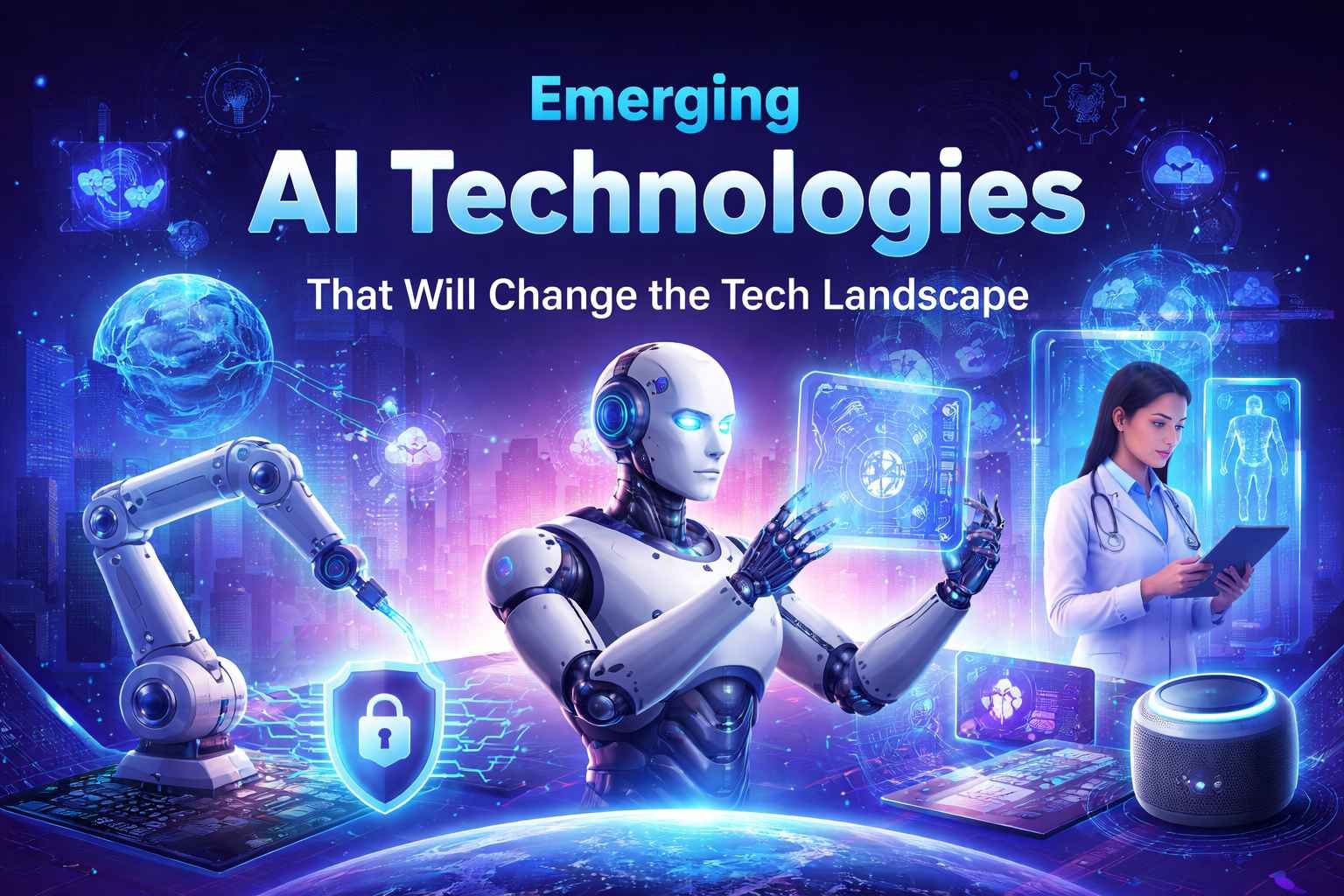
Artificial Intelligence (AI) is no longer just a buzzword—it is transforming the way we live, work, and interact with technology. From businesses automating daily tasks to healthcare predicting diseases, AI technologies are shaping the modern tech landscape. In this article, we’ll look at some of the most exciting emerging AI technologies, their real-world uses, and how they might change our future.
1. Generative AI: Creating Content Smarter and Faster
Generative AI can produce original content, such as text, images, or music, without human input. It goes beyond analyzing data and actively creates something new.
Example: Tools like OpenAI’s GPT models or DALL·E helps marketers, designers, and writers create content quickly. For instance, a social media manager can generate multiple ad copies in minutes instead of hours.
2. AI-Powered Automation and Robotics
Automation powered by AI isn’t just about repetitive tasks anymore. Modern AI robots can learn, adapt, and make decisions in real-time.
Example: Tesla’s autopilot system uses AI at the edge to analyze road conditions and make driving decisions instantly.
3. Explainable AI (XAI): Understanding AI Decisions
As AI systems handle more complex tasks, knowing how they make decisions becomes important. Explainable AI helps humans understand the reasoning behind AI outputs.
Example: IBM Watson explains medical treatment suggestions, allowing doctors to verify and adjust recommendations.
4. AI in Edge Computing: Faster Processing on Devices
Edge computing combines AI with local devices instead of relying entirely on cloud servers. This allows real-time processing and faster responses.
Example: Autonomous drones can detect obstacles immediately using AI on the device rather than sending data to a cloud server.
5. AI in Healthcare: Personalized Treatments
AI is helping healthcare providers predict diseases, create personalized treatment plans, and speed up drug development.
Example: DeepMind’s AlphaFold predicts protein structures, helping scientists discover new medicines faster. AI tools also analyze patient data to recommend personalized treatments.
6. Natural Language Processing (NLP): Smarter Communication
NLP allows computers to understand human language, enabling chatbots, voice assistants, and language translation tools.
Example: Google Translate and AI-powered customer service chatbots can understand context and provide helpful responses.
7. AI in Cybersecurity: Protecting Data Smarter
Cyber threats are growing, and AI helps by detecting unusual activity, predicting attacks, and responding automatically.
Example: Darktrace uses AI to monitor networks and stop cyberattacks in real-time.
Looking Ahead: The Future of AI
AI will continue to evolve rapidly. We can expect more human-AI collaboration, smarter automation tools, and greater use of AI in business decision-making. However, there are challenges too:
- Data privacy: Companies must handle user data responsibly.
- Ethical concerns: Bias in AI algorithms needs to be addressed.
- Human-AI collaboration: Training humans to work with AI effectively will be key.
Businesses and individuals who adopt AI technologies responsibly will stay ahead in the ever-changing tech landscape.
Conclusion
Emerging AI technologies are no longer futuristic—they are changing our world today. From generative AI and automation to healthcare innovations and smarter cybersecurity, these technologies are making our lives easier, safer, and more productive. By understanding and embracing AI, we can prepare for a future where humans and machines work together to achieve remarkable things.