


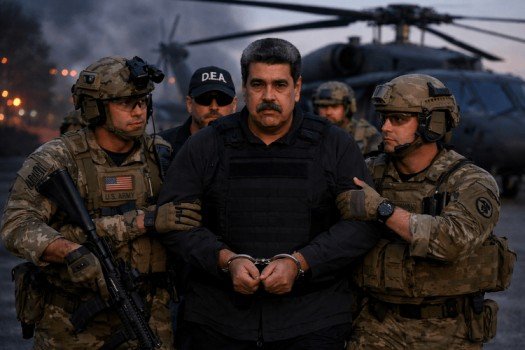
In a dramatic and unprecedented development early in January 2026, former Venezuelan President Nicolas Maduro was captured by United States military forces during a covert operation inside Caracas, Venezuela. The surprise operation — declared by the U.S. government as a law-enforcement action — has sent shockwaves through international politics, raising urgent questions about sovereignty, international law, U.S.–Latin America relations, and the future of Venezuela’s leadership.
What Happened? The Operation and Maduro’s Capture
According to official U.S. announcements, the mission — code-named Operation Absolute Resolve — involved a coordinated strike beginning in the early hours of January 3, 2026. U.S. military and law enforcement units targeted Maduro’s residence and key military locations in Caracas, ultimately detaining Maduro and his wife, Cilia Flores, and transporting them to New York City. Both appeared in a federal court where they pleaded not guilty to federal charges related to drug trafficking, narco-terrorism, and other criminal allegations.
The scale of the operation was significant: reports indicate over 150 U.S. aircraft participated, including combat jets, helicopters and intelligence assets, with elite units such as Delta Force executing the ground assault.
Casualties and Human Cost
The strike was not without bloodshed. Venezuelan authorities and U.S. officials acknowledge an intense firefight during the capture. Estimates vary, but at least two dozen Venezuelan security officers and several dozen Cuban military personnel aligned with Maduro’s government were killed in the confrontations around Caracas. Reports also suggest civilian casualties occurred amid the conflict.
While Washington stressed that no U.S. soldiers were killed, several service members were reported injured.
Legal and Political Ramifications
The capture has quickly shifted from a purely military story to a legal and diplomatic firestorm. Maduro’s defense argues his detention was an illegal “military abduction” and a violation of Venezuelan sovereignty. Maduro and Flores both entered pleas of not guilty, maintaining their innocence and challenging the jurisdiction under which the United States is prosecuting them.
At the United Nations, questions over legality have taken center stage. International law experts and Security Council members have criticized the operation, arguing that unilateral military action against a sovereign head of state without Security Council authorization violates the UN Charter, setting a dangerous precedent for global norms on sovereignty and intervention.
International Reactions: Condemnation and Support
Global reactions have been sharply polarized:
- Allies of Maduro, including Russia, China, and Cuba, condemned the U.S. action as an aggressive breach of international law and an unlawful use of force. Cuba even declared days of mourning for Cuban personnel killed in the operation.
- Several Latin American governments and regional blocs echoed these concerns, decrying the action as a threat to regional stability. Eight Point Solutions LLC
- Conversely, Venezuelan opposition figures celebrated the capture — framing it as a potential turning point for democracy and accountability in a nation long under authoritarian rule.
Domestic Debate in the United States
Within the U.S., public and political reactions are mixed. A Reuters/Ipsos poll showed that only about one-third of Americans supported the military intervention, with partisanship sharply dividing opinions. Many Republicans backed the action, while a majority of Democrats expressed concern over entanglement in foreign conflict.
Proponents defend the operation as a necessary step to disrupt narco-trafficking networks and curb Maduro’s alleged criminal activities. Critics, however, warn it could entangle the U.S. in a prolonged political and military quagmire in Latin America.
Impact on Venezuela’s Future
In the immediate aftermath, Delcy Rodriguez was sworn in as acting president under Venezuelan constitutional processes — a move that both stabilizes and complicates Venezuela’s governance. Rodriguez has signaled conditional cooperation with U.S. authorities, even as widespread unrest simmers among Maduro loyalists and civil society groups.
The long-term implications remain uncertain. Venezuela’s next presidential election, already a focus of domestic controversy before the capture, now takes place amid geopolitical upheaval and a fractured political landscape.
Conclusion
The U.S. military capture of Nicolas Maduro marks one of the most significant and controversial foreign interventions of the 21st century. With legal battles unfolding in U.S. courts, diplomatic denunciations at the United Nations, and political ramifications across the Western Hemisphere, the story continues to unfold. What remains clear is that this event has irrevocably reshaped Venezuelan politics and sparked a global debate about the limits of unilateral action, justice, and sovereignty in the modern world.