

Executive Summary
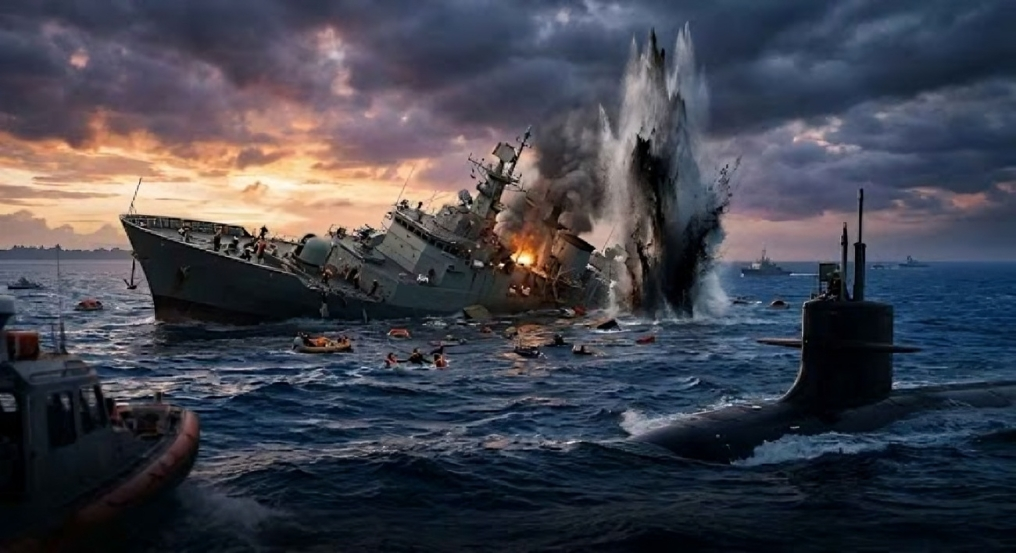
- The Incident: On March 4, 2026, a U.S. Navy Virginia-class fast-attack submarine torpedoed and sank the Iranian Moudge-class frigate IRIS Dena sinking.
- Location: 40 nautical miles south of Galle, Sri Lanka, in the Indian Ocean.
- Casualties: 87 confirmed dead, 61 missing; 32 survivors rescued by Sri Lankan authorities.
- Strategic Impact: This marks the first combat torpedo sinking by a U.S. submarine since WWII. It signals the expansion of Operation Epic Fury from the Persian Gulf into the critical trade arteries of the Indian Ocean.
- Market Reaction: Brent Crude has surged to $142/barrel amid fears of a total maritime blockade and a 400% spike in insurance premiums.
The Lead: A Historic Strike in Neutral Waters
The silent world of undersea warfare collided with global geopolitics in the early hours of March 4, 2026. The Iranian frigate IRIS Dena, returning from the MILAN 2026 naval exercises in India, was intercepted and destroyed by a U.S. Navy fast-attack submarine. This was not a skirmish in the contested waters of the Persian Gulf; it was a lethal execution in the deep blue waters of the Indian Ocean, thousands of miles from the primary theater of conflict.
Pentagon officials have confirmed the use of a Mark 48 ADCAP heavyweight torpedo, which struck the vessel’s keel, causing a catastrophic structural failure. U.S. Defense Secretary Pete Hegseth described the operation as a “quiet death,” noting that it was the first time an American submarine had scored a torpedo kill against an enemy surface vessel since August 1945.
“An American submarine sank an Iranian warship that thought it was safe in international waters,” Hegseth stated during a televised briefing. “Instead, it was met with a quiet death. We are fighting to win, and the message to Tehran is clear: there is no horizon beyond our reach.”
The Strategic Shift: Operation Epic Fury Goes Global
The IRIS Dena sinking is a pivotal moment in Operation Epic Fury, the joint U.S.-Israeli campaign launched on February 28, 2026. What began as a targeted effort to degrade Iran’s nuclear and missile infrastructure within its own borders has now evolved into a transcontinental maritime war.
1. Neutralizing “Blue Water” Ambitions
For years, Tehran has sought to transition from a “green water” navy (limited to coastal defense) to a “blue water” force capable of projecting power across the Indian Ocean and into the Red Sea. By striking near Sri Lanka, the U.S. has effectively neutralized these ambitions. Tehran can no longer safely project power outside the Strait of Hormuz. This “out-of-theater” strike serves as a lethal warning to the Iranian Navy’s remaining assets, specifically the massive sea-base support ship IRIS Makran.
2. The Indian Ocean: A New Front
The choice of location was as much a political statement as a military one. By engaging in the Indian Ocean—a region India considers its strategic backyard—the U.S. has signaled that the rules of engagement have changed. The conflict is no longer a regional dispute; it is a global hunt for Iranian military assets.
The Economic Shockwave: The $142 Barrel
The Indian Ocean is the lifeblood of global trade, carrying the vast majority of the world’s energy and consumer goods. The strike on the Dena has sent a tremor through the global economy that surpasses the shocks of the 2022 energy crisis.
Energy Markets in Turmoil
Following the confirmation of the strike, Brent Crude oil prices spiked 14% in a single day, briefly touching $145 before settling at $142/barrel. Analysts at Goldman Sachs warn that if Iran retaliates by mining the Strait of Hormuz, prices could breach $200, potentially triggering a global recession.
Shipping Routes and Supply Chain Contraction
The “War Risk” premium for maritime insurance has tripled overnight for all vessels transiting the Arabian Sea. Major carriers, including Maersk and MSC, have begun diverting vessels around the Cape of Good Hope. This detour adds roughly 10 to 14 days to transit times between Asia and Europe, effectively halving the world’s available shipping capacity and sending freight rates to record highs.
Technical Breakdown: The Undersea Advantage
The disparity in technology between the two forces was laid bare in the seconds before the Dena vanished.
| Specification | Details |
| Aggressor Platform | Virginia-class Fast-Attack Submarine (SSN) |
| Primary Weapon | Mark 48 ADCAP (Advanced Capability) Torpedo |
| Target Vessel | IRIS Dena (Moudge-class Frigate) |
| Strike Method | Under-keel detonation (creating a lethal gas bubble) |
| Engagement Range | Classified (Beyond Visual Range) |
| Countermeasures | Ineffective (Total surprise achieved) |
The Mark 48 ADCAP is a masterpiece of destructive engineering. Rather than striking the side of the ship, the torpedo is programmed to detonate directly beneath the keel. This creates a massive void—a gas bubble—that causes the ship to sag into the hole before the bubble collapses and rushes upward, snapping the vessel’s spine like a dry twig. This is why the Dena sank so rapidly, leaving little time for the crew to deploy lifeboats.
The Proxy Response: The “Five-Front” Threat
Intelligence reports from the CIA and Mossad suggest that Iran’s “Axis of Resistance” is preparing a coordinated, asymmetric response to the naval loss. This is the feared “Five-Front War” scenario that has long haunted regional planners.
- The Northern Front (Hezbollah): Since the sinking, Hezbollah has significantly increased rocket fire into Northern Israel. Experts believe this is a “distraction campaign” designed to pull Israeli Iron Dome resources away from strategic sites in the south.
- The Red Sea (The Houthis): Yemen’s Houthi rebels have declared “all-out war” on U.S.-flagged merchant shipping. They have reportedly deployed new Iranian-supplied anti-ship cruise missiles at the Bab el-Mandeb chokepoint.
- The Grey Zone (Cyber Warfare): A 400% uptick in DDoS (Distributed Denial of Service) attacks has been detected targeting U.S. and Israeli financial hubs. There are growing fears of “wiper” malware being deployed against Western power grids.
- The Levant (Militias): Iranian-backed militias in Iraq and Syria have resumed drone strikes on U.S. bases in Al-Tanf and Erbil.
The Human and Geopolitical Cost
The tragedy off the coast of Galle has left a devastating human toll. Of the 180 crew members, 87 sailors are confirmed dead, with dozens more likely trapped within the hull. Sri Lanka, while maintaining a policy of strict neutrality, has faced immense pressure. The rescue of 32 survivors by the Sri Lankan Navy was a humanitarian triumph, but it has placed the government in Colombo in a diplomatic vice between Washington and Tehran.
The Indian Reaction
The geopolitical fallout extends to New Delhi. Former Indian Navy officials have called the strike “unnecessarily inflammatory,” noting that the Dena was a “guest” of the Indian Navy just weeks prior at MILAN 2026. There is a growing sense in India that U.S. military strategy is disregarding the stability of regional powers in favor of total military dominance. This friction could strain the Quad alliance at a time when cooperation is most needed.
Detailed FAQ: Understanding the 2026 Conflict
This is the first time since August 14, 1945, that a U.S. Navy submarine has utilized a torpedo to sink an enemy warship in active combat. While the U.S. has used missiles and air strikes for decades, the return to submarine-launched torpedo warfare indicates a shift back to high-intensity “great power” naval conflict.
The U.S. Navy has declared a Maritime Exclusion Zone in specific corridors, but the Indian Ocean is too vast to “close.” However, for any vessel associated with the Iranian government or its affiliates, the region is now an active kill zone.
Historically, Iran favors asymmetric responses. Expect increased activity in the Strait of Hormuz (mining or harassment), cyber-attacks on Western infrastructure, and proxy strikes via Hezbollah or Houthi forces. A direct naval confrontation with the U.S. is unlikely given the technical disparity.
Yes. With Brent Crude at $142 and shipping routes diverted, consumers in the U.S., Europe, and Asia should expect a significant increase in prices at the pump within the next 7 to 10 days. The cost of goods—from electronics to grain—will also rise due to inflated shipping costs.
It is a comprehensive U.S. and Israeli military doctrine designed to dismantle Iran’s nuclear capabilities and its ability to project military force across the Middle East. It combines cyberwarfare, precision air strikes, and submarine operations.
Conclusion: The End of the Shadow War
The sinking of the IRIS Dena is the final, undeniable proof that the era of “Shadow Wars” is over. The clandestine exchanges of the past decade have been replaced by the cold, hard reality of blue-water naval combat.
As 2026 progresses, the conflict between the U.S.-Israel coalition and Iran has moved from the digital realm into the deep ocean. For the global community, the question is no longer if the war will expand—but how far it will go before the world reaches a breaking point. The wreckage of the Dena sitting 3,000 meters below the Indian Ocean serves as a silent monument to a world that has once again entered a period of total maritime uncertainty.
Author Bio: This report was compiled by Amanda Walker Desk using real-time field data and military intelligence from the March 2026 conflict.




Leave a Reply