Amanda Walker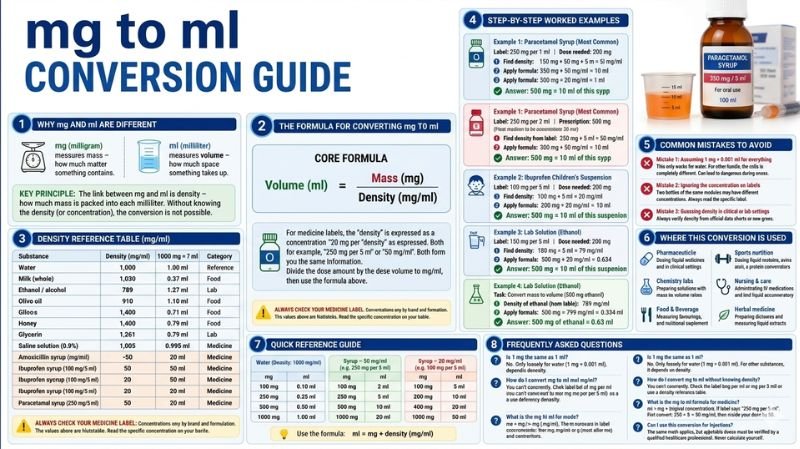
If you’ve ever stared at a medicine bottle trying to figure out how many milliliters to take for a 500 mg dose — you’re not alone. The mg to ml conversion trips up millions of people because these two units measure completely different things.
This guide gives you everything you need: the correct formula, worked examples, density reference tables, common mistakes to avoid, and an FAQ covering the most-searched questions on this topic.
In This Article
| 1. Why mg and ml are different units
2. The formula for converting mg to ml 3. Density reference table 4. Step-by-step worked examples 5. Common mistakes to avoid 6. Where this conversion is used 7. Quick reference guide 8. Frequently asked questions |
1. Why mg and ml Are Different Units
mg (milligram) measures mass — how much matter something contains.
ml (milliliter) measures volume — how much space something takes up.
This is why you cannot simply say “1 mg = 0.001 ml” for every substance. That rule only works for pure water. A thicker substance like honey weighs far more per milliliter than water, so the same number of milligrams takes up less space.
| Key Principle |
| The link between mg to ml is density — how much mass is packed into each milliliter. Without knowing the density (or concentration), the conversion is not possible. |
2. The Formula for Converting mg to ml
The conversion formula is straightforward once you have the density or concentration of your substance:
| CORE FORMULA
Volume (ml) = Mass (mg) ÷ Density (mg/ml) Divide the weight in mg by how many mg are packed into each ml. |
For medicine labels, the “density” is expressed as a concentration — for example, “250 mg per 5 ml” or “50 mg/ml.” Both forms give you the same information. Simply divide the dose amount by the dose volume to get mg to ml, then use the formula above.
3. Density Reference Table
Use this table to look up the density of common substances, then plug the value into the formula. Medicine concentrations vary by brand — always check your specific label.
| Substance | Density (mg/ml) | 1000 mg = ? ml | Category |
| Water | 1,000 | 1.00 ml | Reference |
| Milk (whole) | 1,030 | 0.97 ml | Food |
| Ethanol / alcohol | 789 | 1.27 ml | Lab |
| Olive oil | 910 | 1.10 ml | Food |
| Honey | 1,400 | 0.71 ml | Food |
| Glycerin | 1,261 | 0.79 ml | Lab |
| Saline solution (0.9%) | 1,005 | 0.995 ml | Medicine |
| Amoxicillin syrup (typical) | ~50 | 20 ml | Medicine |
| Ibuprofen syrup (100 mg/5 ml) | 20 | 50 ml | Medicine |
| Paracetamol syrup (250 mg/5 ml) | 50 | 20 ml | Medicine |
| ⚠️ Always Check Your Medicine Label |
| Medicine concentrations vary significantly between brands and formulations. The values above are illustrative. Always read the specific concentration printed on your bottle before calculating a dose. |
4. Step-by-Step Worked Examples
Example 1: Paracetamol Syrup (Most Common)
| Medicine label: 250 mg per 5 ml
The prescription says 500 mg. The bottle reads: 250 mg per 5 ml. How many ml? Step 1: Find density from the label: 250 mg ÷ 5 ml = 50 mg/ml Step 1: Apply formula: 500 mg ÷ 50 mg/ml = 10 ml
✓ Answer: 500 mg = 10 ml of this syrup |
Example 2: Ibuprofen Children’s Suspension
| Medicine label: 100 mg per 5 ml
Child weighing 20 kg needs 10 mg/kg (= 200 mg). Bottle reads: 100 mg per 5 ml. How many ml? Step 2: Find density: 100 mg ÷ 5 ml = 20 mg/ml Step 2: Apply formula: 200 mg ÷ 20 mg/ml = 10 ml
✓ Answer: 200 mg = 10 ml of this suspension |
Example 3: Lab Solution (Ethanol)
| Lab task: Convert mass to volume
You need to pipette 500 mg of ethanol. Your balance measures mass. How many ml is that? Step 3: Density of ethanol (from reference table): 789 mg/ml Step 3: Apply formula: 500 mg ÷ 789 mg/ml = 0.634 ml
✓ Answer: 500 mg of ethanol ≈ 0.63 ml |
5. Common Mistakes to Avoid
| ❌ Mistake 1: Assuming 1 mg = 0.001 ml for everything |
| This only works for water. For medicine syrups, oil, alcohol, and other liquids the ratio is completely different. Using this shortcut with medicines can lead to dangerous dosing errors. |
| ❌ Mistake 2: Ignoring the concentration on medicine labels |
| Two bottles both labeled “ibuprofen” may have different concentrations — for example, 100 mg/5 ml vs 200 mg/5 ml. Always read the specific label, not just the drug name. |
| ❌ Mistake 3: Confusing “mg per dose” with “mg/ml” |
| A label saying “250 mg per 5 ml” means the concentration is 50 mg/ml — not 250 mg/ml. Divide the dose amount by the dose volume first to get the actual density. |
| ❌ Mistake 4: Guessing density in clinical or lab settings |
| In any professional setting, always verify density from official data sheets or pharmacology references. Guessing introduces errors that can have serious consequences. |
6. Where This Conversion Is Used
| Field | How mg-to-ml conversion is applied |
| Pharmaceuticals | Dosing liquid medicines at home and in clinical settings |
| Chemistry labs | Preparing solutions with precise mass-to-volume ratios |
| Food & beverage | Measuring flavourings, additives, and nutritional supplements |
| Sports nutrition | Dosing liquid vitamins, amino acids, and protein concentrates |
| Nursing & care | Administering IV medications and oral liquid doses accurately |
| Herbal medicine | Preparing tinctures and measuring liquid herbal extracts |
7. Quick Reference Guide
Pre-calculated values for the most common substances and doses:
Water (Density: 1000 mg/ml)
| mg | ml | mg | ml |
| 100 mg | 0.10 ml | 500 mg | 0.50 ml |
| 250 mg | 0.25 ml | 1000 mg | 1.00 ml |
Medicine Syrup — 50 mg/ml (e.g. 250 mg per 5 ml)
| mg | ml | mg | ml |
| 100 mg | 2 ml | 500 mg | 10 ml |
| 250 mg | 5 ml | 1000 mg | 20 ml |
Medicine Syrup — 20 mg/ml (e.g. 100 mg per 5 ml)
| mg | ml | mg | ml |
| 100 mg | 5 ml | 400 mg | 20 ml |
| 200 mg | 10 ml | 1000 mg | 50 ml |
8. Frequently Asked Questions
Is 1 mg the same as 1 ml?
No. 1 mg equals 1 ml only loosely for pure water (technically 1 mg = 0.001 ml of water, since water’s density is 1000 mg/ml). mg to ml for all other substances, the relationship depends on density. A milligram of honey, for example, mg to ml takes up far less space than a milligram of alcohol.
How many ml is 500 mg?
It depends on the substance. For water: 500 mg = 0.5 ml. For a paracetamol syrup at 250 mg/5 ml: 500 mg = 10 ml. For a medicine at 50 mg to ml: 500 mg = 10 ml. Always check the density or label concentration of your specific substance.
How do I convert mg to ml without knowing the density?
You cannot make an accurate conversion without the density or concentration. For medicines, the label almost always provides this information — look for “mg to ml” or “mg per 5 ml” on the packaging. For other substances, consult a density reference table like the one in Section 3.
How many ml is 1000 mg?
For water: 1000 mg = 1 ml exactly. For a 50 mg to ml medicine syrup: 1000 mg = 20 ml. For olive oil: 1000 mg ≈ 1.10 ml. Use the formula: ml = mg ÷ density (mg/ml). See the Quick Reference Guide in Section 7 for more values.
What is the mg to ml formula for medicine?
ml = mg ÷ (mg/ml concentration). If the label says “250 mg per 5 ml,” first convert: 250 ÷ 5 = 50 mg/ml. Then divide your dose by 50 to get ml. Example: 750 mg ÷ 50 mg/ml = 15 ml.
Can I use this conversion for injections?
The same formula applies mathematically, but for injections the stakes are much higher. mg to ml Injectable doses must always be verified by a qualified healthcare professional. Never calculate injection volumes yourself for clinical use without professional oversight.
Why does the same mg give a different ml for different medicines?
Because each medicine has a different concentration — different amounts of active ingredient per milliliter of liquid. mg to ml A manufacturer may dilute the same ingredient more or less depending on the patient age group, dosing interval, taste, or shelf-life requirements. This is why reading the specific label is essential every time.