Amanda Walker
For more than a century, Chevrolet has been one of the most recognizable names in the American automotive industry. From the roaring muscle cars of the 1960s to today’s Silverado trucks and Equinox EVs, Chevy has built a reputation as a symbol of American engineering, hard work, and innovation. Many consumers automatically equate the Bowtie badge with Detroit, classic Americana, and vehicles built on U.S. soil.
But in today’s globalized economy, the question of whether a vehicle is “American made” is no longer black and white. Modern automobiles rely on international supply chains, global components, and factories spread across multiple continents. Even the most iconic American brands assemble vehicles overseas, while foreign automakers build cars right here in the United States.
| Quick Answer: Chevrolet is unquestionably an American brand — but not every Chevrolet is American made. Some models, like the Corvette, are built almost entirely in the U.S. Others, like the Trax, are assembled in South Korea. The reality depends on the specific model, trim, and model year. |
1. The Origins of Chevrolet: An American Brand Through and Through
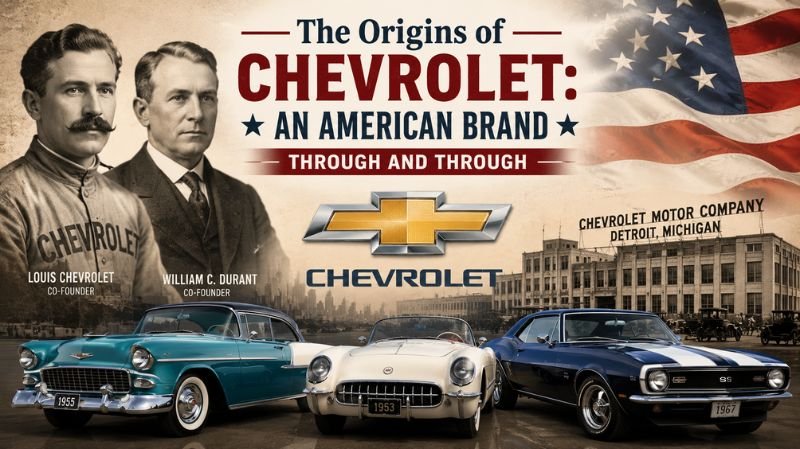
Chevy was founded on November 3, 1911, in Detroit, Michigan, by Swiss-American racing driver Louis Chevrolet and General Motors founder William C. Durant. Detroit was the beating heart of America’s emerging auto industry, and Chevrolet rapidly established itself as a worthy rival to the dominant Ford Motor Company.
By 1918, Chevrolet had officially become part of General Motors (GM), one of the largest corporations in the world. Over the following century, the brand became deeply woven into the fabric of American culture through vehicles that defined entire eras:
- 1955 Chevrolet Bel Air — a post-war symbol of American prosperity
- 1953 Chevrolet Corvette — America’s sports car, still made in Kentucky today
- 1967 Chevrolet Camaro — born as a direct rival to the Ford Mustang
- Chevrolet Silverado — consistently one of the top-selling vehicles in the U.S.
- Chevrolet Suburban — the world’s longest-running production nameplate, since 1935
The brand’s 1990s slogan, “Like a Rock,” cemented Chevy’s image as a rugged, dependable, all-American brand built for hardworking people. That heritage is real — but heritage does not automatically equal domestic manufacturing.
2. What Does “American Made” Actually Mean?
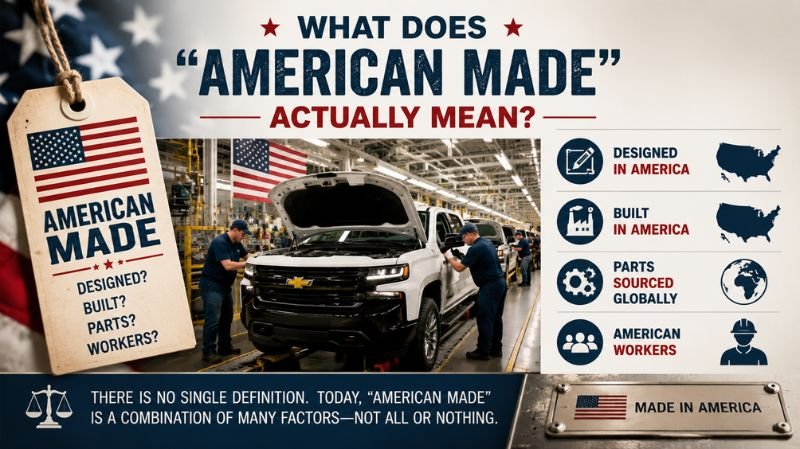
Before answering whether Chevy is American made, it is essential to define what that phrase actually means in the context of modern vehicle production.
Most consumers assume an American-made vehicle is designed in America, built in America, with American parts, by American workers. That definition made sense in 1955. Today, it is nearly impossible for any automaker — domestic or foreign — to meet all four criteria.
The American Automobile Labeling Act (AALA)
Because of this complexity, the U.S. government passed the American Automobile Labeling Act (AALA), requiring automakers to disclose specific manufacturing information on every new vehicle sold in the United States. Each window sticker must show:
- Percentage of U.S. and Canadian parts content
- Final assembly location (city and country)
- Country of origin for the engine
- Country of origin for the transmission
Critically, U.S. and Canadian parts are counted together under AALA. This means a vehicle assembled in Michigan with 40% Canadian parts and 10% U.S. parts would show “50% U.S./Canadian content” on the label — which can be misleading for consumers who want strictly American-made products.
| Key Insight: Under AALA rules, a Toyota Tundra assembled in San Antonio, Texas can rank higher in domestic content than a Chevrolet Silverado assembled in Silao, Mexico. The brand name on the hood does not determine how American the vehicle is. |
The USMCA Trade Agreement and Its Impact
The United States-Mexico-Canada Agreement (USMCA), which replaced NAFTA in July 2020, dramatically influences where and how Chevrolet vehicles are assembled. Under USMCA:
- 75% of a vehicle’s components must originate from North America to qualify for zero tariffs (up from 62.5% under NAFTA)
- 40-45% of vehicle content must be made by workers earning at least $16/hour
- Steel and aluminum content requirements were tightened
This means that while Chevy assembles some vehicles in Mexico, those vehicles must still use a significant proportion of North American content to avoid tariffs. USMCA has pushed GM to source more components domestically across all its brands, including Chevrolet.
3. Where Are Chevy Vehicles Made? A Complete Manufacturing Breakdown
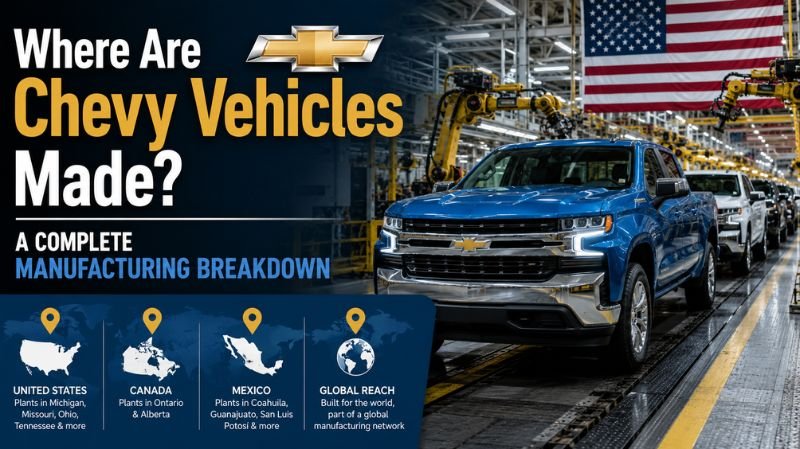
Chevrolet operates manufacturing facilities across multiple countries. The table below shows key U.S. assembly plants currently producing Chevrolet vehicles, based on GM’s 2024 manufacturing data:
| Plant Location | Vehicles Produced | Est. Employees | Notes |
|---|---|---|---|
| Bowling Green, KY | Corvette (C8) | ~1,000 | Corvette made here since 1981 |
| Fort Wayne, IN | Silverado 1500 | ~3,700 | Largest GM truck plant |
| Flint, MI | Silverado HD (2500/3500) | ~3,000 | Heavy-duty trucks |
| Arlington, TX | Tahoe, Suburban | ~5,000 | Also builds GMC Yukon |
| Wentzville, MO | Colorado, Express Van | ~4,700 | Mid-size truck hub |
| Lansing, MI (Grand River) | Camaro | ~1,500 | Performance vehicles |
| Spring Hill, TN | Cadillac XT5/XT6 (GM platform shared with Chevy) | ~3,600 | GM multi-brand plant |
Source: General Motors 2024 Annual Report; UAW local union data. Employee figures are approximate.
Chevy Manufacturing in Mexico
Mexico plays a major role in Chevrolet’s modern manufacturing strategy. General Motors operates significant facilities in Silao, Guanajuato — one of GM’s largest assembly plants globally. Mexico-assembled Chevy products include:
- Silverado 1500 (certain trims and configurations)
- Selected SUV and crossover variants
- Various components and sub-assemblies shipped to U.S. plants
GM’s investment in Mexico is driven by labor cost differentials, geographic proximity to U.S. markets, USMCA trade benefits, and established automotive supply chains in the Bajio region. The Silao plant alone employs approximately 6,500 workers and is one of GM’s highest-volume production facilities worldwide.
Critics argue this outsourcing costs American jobs. Supporters counter that it allows GM to remain price-competitive, protecting the broader U.S. operations and hundreds of thousands of related domestic jobs in dealerships, suppliers, and engineering centers.
Chevy Manufacturing in South Korea
GM Korea — formerly Daewoo — produces several smaller Chevrolet vehicles, primarily for global markets. Vehicles assembled in South Korea include:
- Chevrolet Trax (current generation)
- Chevrolet Trailblazer
- Various compact and subcompact models sold outside North America
These Korean-built vehicles typically have very low U.S./Canadian parts content — often below 10% — making them among the least “American made” vehicles wearing the Chevy badge.
Chevy Manufacturing in Canada
Canada has deep historical ties to U.S. auto manufacturing. While GM has reduced its Canadian footprint significantly since closing the Oshawa plant in 2019 (later reopened in 2022 for commercial vehicles), Canada remains part of GM’s integrated North American supply network. Under AALA rules, Canadian content counts alongside U.S. content, which can inflate domestic content percentages on window stickers.
Chevy Manufacturing in China
General Motors operates extensive joint ventures in China, primarily through SAIC-GM. However, Chinese-manufactured Chevrolets are generally sold in the Chinese domestic market and are not imported into the United States. China represents a critical revenue source for GM globally but has minimal direct bearing on the American-made question.
4. How American Is YOUR Chevy? Model-by-Model Domestic Content Breakdown
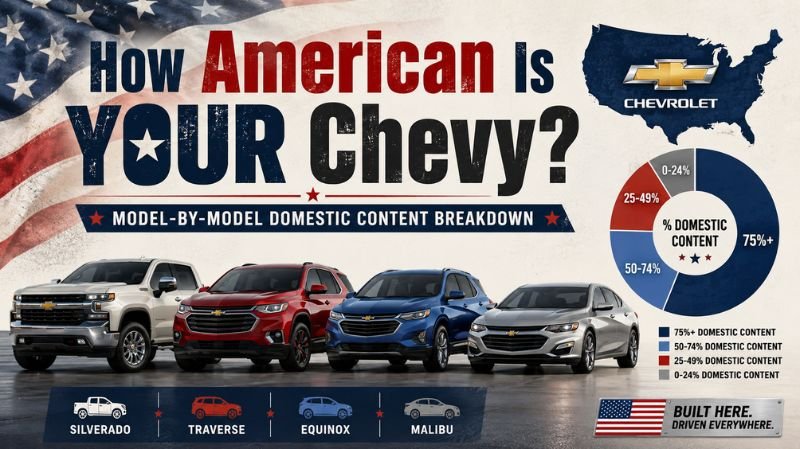
The table below provides estimated domestic content data based on recent NHTSA AALA disclosures. Note that content percentages can vary by trim level, model year, and production run. Always verify using the official NHTSA database at vpic.nhtsa.dot.gov before purchasing.
| Model | Assembly Location | U.S./CA Parts % | Engine Origin | Rating |
|---|---|---|---|---|
| Corvette C8 | Bowling Green, KY | ~75%+ | USA | Highly American |
| Tahoe / Suburban | Arlington, TX | ~70% | USA | Highly American |
| Silverado 1500 (Fort Wayne) | Fort Wayne, IN | ~55–60% | USA/Mexico | Moderately American |
| Silverado 1500 (Silao) | Silao, Mexico | ~40–50% | USA/Mexico | Partly American |
| Colorado | Wentzville, MO | ~60% | USA | Moderately American |
| Camaro | Lansing, MI | ~65% | USA | Mostly American |
| Silverado HD | Flint, MI | ~65% | USA | Mostly American |
| Equinox (gas) | Mexico / Canada | ~30–45% | Mexico/China | Partly American |
| Trax | South Korea | ~5–10% | South Korea | Not American |
| Trailblazer | South Korea | ~5–10% | South Korea | Not American |
Note: Percentages are estimates based on publicly available AALA data. Verify specific model year data at vpic.nhtsa.dot.gov. Parts content can vary by trim level.
5. The Silverado Debate: America’s Truck or a Global Product?
No vehicle represents American culture more than the Chevrolet Silverado — consistently the second or third best-selling vehicle in the United States, trailing only the Ford F-150 and occasionally the Ram 1500. Chevy markets it as the ultimate working truck for ranchers, contractors, and outdoor enthusiasts.
The reality is more nuanced. Silverado production is split across multiple facilities:
- Fort Wayne, Indiana — Silverado 1500 (regular and crew cab, majority of production)
- Flint, Michigan — Silverado HD (2500 and 3500 heavy-duty)
- Silao, Mexico — Silverado 1500 (certain configurations and overflow production)
When you buy a Silverado 1500, the assembly location depends on the cab configuration, trim level, powertrain selection, and current production scheduling. A buyer purchasing a Silverado LTZ crew cab from Fort Wayne, Indiana is getting a materially different domestic-content product than someone buying a base-trim Silverado assembled in Silao.
| How to check your specific Silverado: Look at the window sticker’s AALA label, or decode the VIN at vpic.nhtsa.dot.gov. The 11th character of your VIN identifies the assembly plant. Plants beginning with ‘1’ (Fort Wayne) or ‘2’ (Flint) are U.S.-assembled; Silao Mexico uses a different prefix. |
Furthermore, even U.S.-assembled Silverados contain internationally sourced components. Electronic systems, certain steel grades, interior materials, and infotainment hardware may originate from suppliers in Asia, Europe, or Mexico — even when the final assembly is in Indiana or Michigan.
For comparison: the Ford F-150 has a similar split between Kansas City, Missouri (domestic) and Dearborn, Michigan assembly. The Ram 1500 is assembled in Sterling Heights, Michigan. No major truck is free of global supply chain involvement.
6. Is Chevy More American Than Toyota, Honda, or Ford?
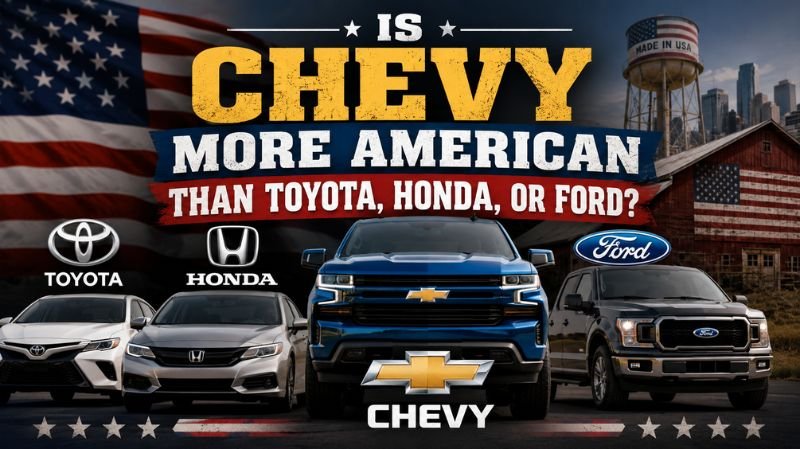
One of the most common misconceptions in the auto industry is assuming that American-branded vehicles automatically contain more domestic content than vehicles from Japanese, German, or Korean brands. The data tells a more complex story.
| Vehicle | Assembly Location | U.S./CA Parts % | Brand Origin |
|---|---|---|---|
| Toyota Tundra | San Antonio, TX | ~75%+ | Japanese brand, mostly American made |
| Honda Accord | Marysville, OH | ~70% | Japanese brand, mostly American made |
| BMW X5 | Spartanburg, SC | ~55%+ | German brand, partly American made |
| Hyundai Santa Fe | Montgomery, AL | ~45% | Korean brand, partly American made |
| Chevy Corvette | Bowling Green, KY | ~75%+ | American brand, mostly American made |
| Chevy Tahoe | Arlington, TX | ~70% | American brand, mostly American made |
| Chevy Trax | South Korea | ~5–10% | American brand, NOT American made |
| Ford F-150 | Dearborn, MI / Kansas City, MO | ~55–65% | American brand, largely American made |
The takeaway: brand nationality and domestic content are two separate metrics. A consumer who genuinely wants to maximize American manufacturing support should research individual models — not just brand logos.
7. The UAW Factor: Labor Unions and Chevrolet Manufacturing
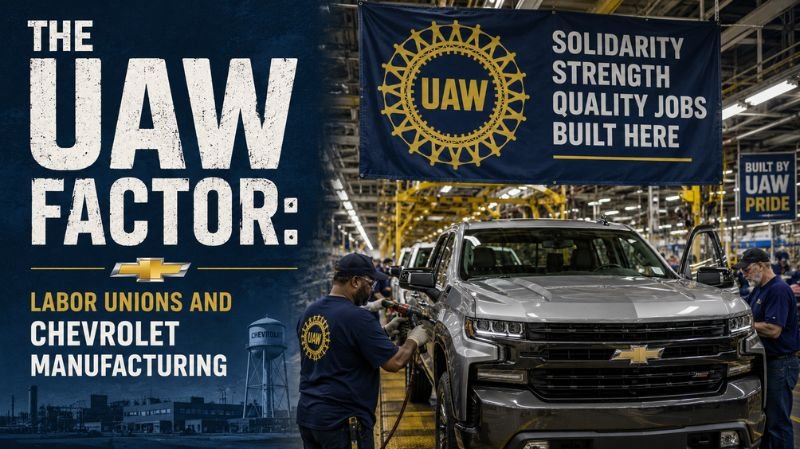
No discussion of Chevy American manufacturing footprint is complete without addressing the United Auto Workers (UAW) union — the labor organization that represents most of GM’s American assembly workers.
The 2019 GM Strike
In September 2019, approximately 49,000 UAW workers walked off the job in the largest GM strike since 1970. The strike lasted 40 days and centered on several key disputes:
- Profit sharing and wages — workers wanted a greater share of GM’s record profits
- Temporary worker conversion — UAW demanded more full-time positions
- Plant closures — GM had announced the idling of four U.S. plants, eliminating approximately 6,000 jobs
- Mexican manufacturing expansion — workers pushed back against GM shifting production to lower-cost Mexican facilities
The strike ultimately resulted in a new four-year contract that included pay raises, a $11,000 signing bonus, a path to permanent employment for temporary workers, and commitments to invest in some U.S. facilities. The Lordstown, Ohio assembly plant, however, remained closed.
The 2023 UAW Strike
In September 2023, the UAW launched its first-ever simultaneous strike against all three Detroit automakers — GM, Ford, and Stellantis — under the leadership of new UAW president Shawn Fain. Key demands included:
- 40% wage increases over four years
- Restoration of cost-of-living adjustments (COLA)
- Shorter workweeks with maintained pay
- Protections for workers transitioning to EV manufacturing jobs
The GM settlement, reached in late October 2023, included approximately 25% in wage increases, restored COLA provisions, faster paths to top wages, and commitments to include battery plant workers under the national UAW contract. This was a significant victory for workers and has implications for Chevy’s domestic cost structure going forward.
| Why This Matters for “American Made”: UAW contracts directly affect how many American workers build Chevy vehicles, what they earn, and whether production stays domestic. A stronger UAW generally means more American-made content in GM vehicles. |
8. Chevrolet and Electric Vehicles: The New American-Made Question
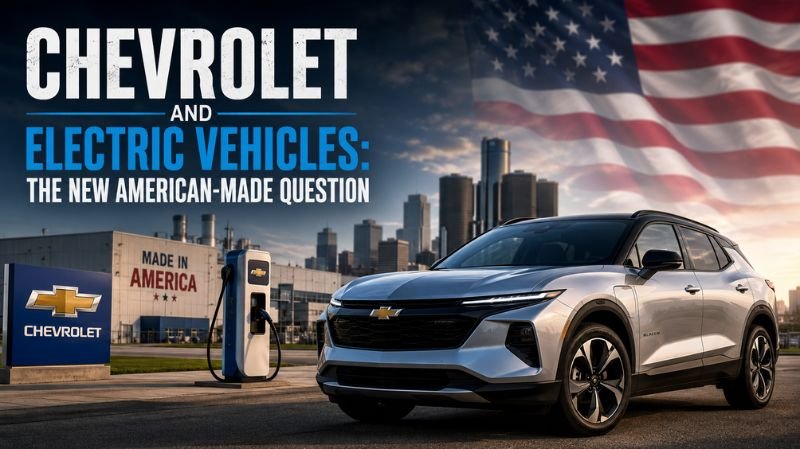
The electric vehicle transition is reshaping what “American made” means in the automotive industry. Chevy has committed billions of dollars to its EV lineup, with several models already on the market and more in development.
Current and Upcoming Chevy EV Models
- Chevrolet Bolt EV / Bolt EUV — assembled in Orion, Michigan (production restarted 2024)
- Chevrolet Equinox EV — assembled in Spring Hill, Tennessee
- Chevrolet Blazer EV — assembled in Spring Hill, Tennessee
- Chevrolet Silverado EV — assembled in Detroit, Michigan (Factory ZERO)
The Ultium Battery Platform
GM’s EV strategy is built around its proprietary Ultium battery platform, developed in partnership with LG Energy Solution. GM has committed to building a series of Ultium Cells LLC battery manufacturing facilities in the United States:
- Spring Hill, Tennessee — Ultium Cells plant operational
- Lordstown, Ohio — Ultium Cells plant operational (bringing jobs back to a previously shuttered GM site)
- Lansing, Michigan — Ultium Cells plant planned/under development
- Silao, Mexico — Battery manufacturing partnership (mixed domestic/international)
GM has announced over $35 billion in EV and autonomous vehicle investment through 2025, with a significant portion directed to U.S. manufacturing. The Inflation Reduction Act (IRA) of 2022 further incentivized domestic EV battery production, with tax credits available for vehicles assembled in North America using domestically sourced battery materials.
The Battery Materials Challenge
Here is where the EV “American made” question becomes truly complex. Even when EVs are assembled in the U.S., their battery materials typically come from global sources:
- Lithium — primarily from Australia, Chile, and Argentina
- Cobalt — primarily from the Democratic Republic of Congo
- Nickel — from Indonesia, Philippines, and Russia
- Rare earth elements — largely from China
The IRA includes provisions designed to shift more of this supply chain to the United States and friendly trading partners over time, but full domestic battery material sourcing remains years away. For now, “American-made” EVs contain globally sourced critical minerals, regardless of where the vehicle is assembled.
9. How to Check if YOUR Specific Chevy Is American Made
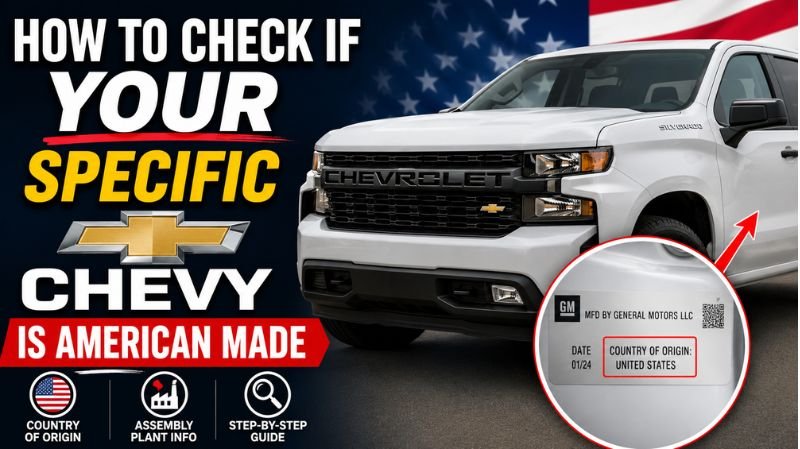
Rather than relying on general brand assumptions, every consumer can verify the domestic content of a specific vehicle using free government resources. Here is a step-by-step guide:
Method 1: The Window Sticker (Easiest)
Every new vehicle sold in the United States must display an AALA label as part of its Monroney window sticker. Look for the section labeled “Parts Content Information” which will show:
- Percentage of U.S. and Canadian parts
- Country of origin for the engine
- Country of origin for the transmission
- Final assembly point (city and country)
Method 2: NHTSA VIN Decoder (Most Accurate)
For a specific vehicle — including used cars — you can look up the exact AALA data using the VIN:
- Go to vpic.nhtsa.dot.gov/api/vehicles/DecodeVinValues/[YOUR-17-DIGIT-VIN]?format=json
- Or use the consumer-friendly tool at nhtsa.gov/vehicle-safety/vehicle-research
- Search for your VIN to see plant of manufacture and parts origin data
Method 3: Decode the VIN Yourself
The 11th character of every vehicle VIN identifies the manufacturing plant. For Chevrolet:
- ‘Z’ = Fort Wayne, Indiana (Silverado 1500 — U.S.)
- ‘F’ = Flint, Michigan (Silverado HD — U.S.)
- ‘R’ = Arlington, Texas (Tahoe, Suburban — U.S.)
- ‘1’ = Bowling Green, Kentucky (Corvette — U.S.)
- ‘J’ = Janesville (historical) / various — check full VIN decoder
- ‘G’ = Silao, Mexico (Silverado 1500 — Mexico)
Note: VIN plant codes vary by model year and are periodically updated. Always cross-reference with the NHTSA VIN decoder for the most accurate result.
10. Chevrolet’s Impact on the American Economy
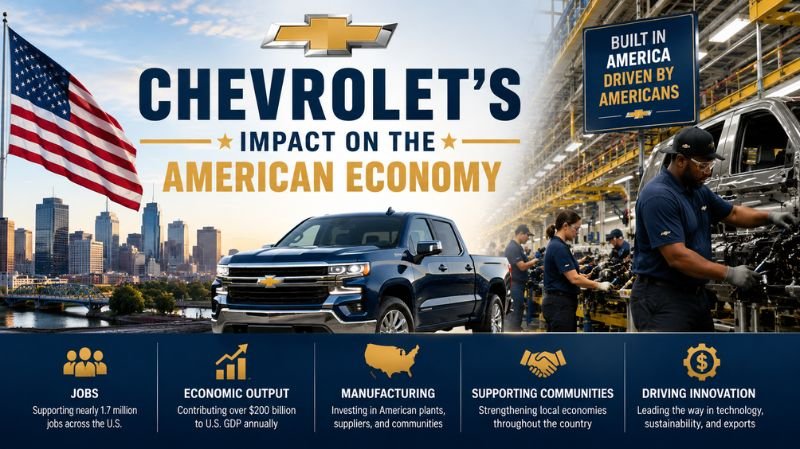
Setting aside parts sourcing debates, Chevy footprint in the American economy is substantial and measurable. According to GM’s 2024 Annual Report and publicly available economic data:
- GM employs approximately 86,000 people in the United States directly
- GM supports an estimated 600,000+ additional jobs through its U.S. supplier network and dealerships
- GM paid approximately $8.2 billion in U.S. taxes in 2023
- GM has invested over $23 billion in U.S. operations over the past five years
- There are approximately 2,900 Chevrolet dealerships in the United States, each employing dozens of workers
| Perspective: Even when a Chevy is assembled in Mexico, it typically travels through a U.S. port, is delivered by American truckers, sold by American dealership employees, financed through American banks, and serviced by American mechanics. The economic ripple effect of any Chevy purchase touches American workers at multiple points. |
11. Debunking Common Myths About Chevy and American Manufacturing
Myth 1: Every Chevy Is Built in America
False. The Trax is assembled in South Korea. The Trailblazer is assembled in South Korea. Several Equinox variants are assembled in Mexico. And many components in U.S.-assembled Chevys come from international suppliers. Brand origin does not equal manufacturing location.
Myth 2: Foreign Brands Don’t Build Cars in America
False. Toyota assembles the Tundra in Texas, the Camry in Kentucky, and the Corolla in Alabama. Honda builds the Accord and CR-V in Ohio. BMW builds all its X-series SUVs in South Carolina — many of which are exported to other countries. These plants employ tens of thousands of American workers.
Myth 3: American Made Means 100% American Parts
False. There is no vehicle sold in the United States — from any brand — that contains 100% American-sourced components. Even the highest-rated domestic content vehicles contain some internationally sourced parts. The semiconductor shortage of 2021-2023 exposed just how globally integrated automotive supply chains truly are.
Myth 4: Buying a Chevy Always Supports American Jobs More Than Buying a Toyota
Not necessarily. A Toyota Tundra assembled in Texas with 75%+ domestic parts content supports more American manufacturing jobs per vehicle than a Chevy Trax assembled in South Korea with 5% domestic content. The right comparison is model-to-model, not brand-to-brand.
Myth 5: GM Doesn’t Care About American Manufacturing
False. GM has committed tens of billions of dollars to U.S. manufacturing, particularly for EVs. The Ultium battery plants, the Factory ZERO Silverado EV facility in Detroit, and the restart of Bolt production in Orion, Michigan are all evidence of ongoing domestic investment. The picture is complicated, but dismissing GM’s U.S. commitment entirely is inaccurate.
12. Buyer’s Guide: Best Chevys to Buy If American Manufacturing Matters to You
If supporting domestic manufacturing is a priority, here is our practical model-by-model recommendation guide based on available AALA data:
Best Choice: Highest Domestic Content
| Model | Assembly | Why It Qualifies |
|---|---|---|
| Corvette C8 | Bowling Green, KY | Over 75% U.S./Canadian content; assembled in Kentucky since 1981; engine made in USA |
| Silverado HD (2500/3500) | Flint, MI | Strong domestic content; iconic Flint, Michigan plant; engine and transmission from U.S. |
| Tahoe / Suburban | Arlington, TX | Approximately 70% domestic content; assembled in Texas; U.S. engine |
Good Choice: Moderate Domestic Content
| Model | Assembly | Notes |
|---|---|---|
| Silverado 1500 (Fort Wayne) | Fort Wayne, IN | Verify trim: Fort Wayne-built units have significantly higher domestic content than Silao-built |
| Colorado | Wentzville, MO | Solid domestic assembly; mid-size truck with good parts content |
| Camaro | Lansing, MI | High domestic content; however, Camaro may be discontinued after 2024 — verify availability |
Caution: Lower Domestic Content
| Model | Assembly | Notes |
|---|---|---|
| Trax | South Korea | Among the lowest domestic content of any Chevy sold in the U.S. — typically 5-10% |
| Trailblazer | South Korea | Similar to Trax; minimal American manufacturing content |
| Equinox (gas, certain trims) | Mexico / Canada | Domestic content varies significantly by trim — always check the specific window sticker |
13. The Future of American Car Manufacturing and Chevrolet’s Role
The automotive industry is undergoing its most dramatic transformation since the invention of the assembly line. Several forces are reshaping what “American made” will mean over the next decade:
Electrification and Domestic Battery Production
The Inflation Reduction Act’s EV tax credits are contingent on North American assembly and domestically sourced battery materials. This creates strong financial incentives for GM and Chevy to bring more EV production — and eventually more battery material sourcing — onshore. Expect domestic EV content to increase over time.
Automation and Reshoring
As robotics and automation reduce the labor cost advantage of overseas manufacturing, some production that moved abroad may eventually return to the United States. GM’s factory modernization investments include significant automation that makes U.S. manufacturing more cost-competitive.
Geopolitical Supply Chain Risks
The COVID-19 pandemic and subsequent semiconductor shortage exposed the fragility of global supply chains. Automakers including GM are actively diversifying and regionalizing their supply chains to reduce dependence on single-country sources, particularly for semiconductors and battery materials.
Tariff and Trade Policy Uncertainty
Changes in U.S. trade policy — including tariffs on imported vehicles and components — can rapidly shift the economics of where vehicles are assembled. GM’s manufacturing footprint will continue to evolve in response to trade policy changes, which may move production in either direction depending on the political environment.
Final Verdict: Is Chevy American Made?
| Chevrolet is definitively an American brand. It is not definitively an American-made vehicle — that depends entirely on which model you buy. |
Here is the honest, data-driven answer:
- Chevrolet was founded in America, is headquartered in America, and is owned by General Motors — a company with deep American roots
- Several Chevrolet models — particularly the Corvette, Tahoe, Suburban, Silverado HD, and Colorado — are assembled in the United States with strong domestic parts content
- Other Chevrolet models — particularly the Trax and Trailblazer — are assembled in South Korea with minimal American manufacturing involvement
- Even American-assembled Chevys rely on internationally sourced components
- Some foreign-branded vehicles assembled in the U.S. (Toyota Tundra, Honda Accord) contain more domestic content than certain Chevy models
The bottom line for consumers: if supporting American manufacturing matters to you, do not buy a car badge — buy a VIN number. Research the specific model, check the AALA window sticker, verify the assembly plant, and compare parts content percentages. The data is freely available and tells a far more accurate story than any marketing slogan.
Chevrolet has been part of America’s story for over a century. That story, like modern manufacturing itself, is more global than it once was — but it remains, at its core, an American one.
Sources & Further Reading
- General Motors 2024 Annual Report — investor.gm.com
- NHTSA American Automobile Labeling Act Database — vpic.nhtsa.dot.gov
- United Auto Workers Union — uaw.org
- U.S. Trade Representative: USMCA Agreement — ustr.gov/trade-agreements/free-trade-agreements/united-states-mexico-canada-agreement
- U.S. Department of Energy: EV Tax Credit Requirements — energy.gov
- Cars.com American-Made Index (annual publication) — cars.com
- GM Ultium Battery Platform Overview — gm.com/electric/ultium
- Automotive News: GM Manufacturing Coverage — autonews.com