Amanda Walker
Apple TV+’s dystopian hit Silo has built its reputation on layered mysteries, and few of them nag at fans quite like “the Syndrome.” Unlike the Safeguard Procedure or the true origins of the silos themselves, the Syndrome is a quieter, more personal kind of horror — a degenerative illness that creeps through the underground population, forcing the people it touches into secrecy and shame. If you have finished an episode wondering exactly what this condition is, what causes it, and why it matters so much to the story, this guide breaks down everything currently known.
What Is the Syndrome in Silo?
The Syndrome is a mysterious illness that afflicts a portion of the residents living inside the underground silo depicted in the show. It is never formally diagnosed on screen with a scientific name, and no doctor ever explains its root cause in full. Instead, viewers learn about it the way the citizens of the silo do: through warning posters, hushed conversations, and the visible symptoms of the people suffering from it.
Importantly, the Syndrome does not appear anywhere in Hugh Howey’s original Silo book trilogy (Wool, Shift, and Dust), which the series is based on. It was invented specifically for the television adaptation, which means show creator Graham Yost and his writers room built it from scratch as a way to deepen the psychological and social stakes of life underground.
How the Syndrome Was Introduced

The first hint of the Syndrome’s existence appears early in Season 1, on a signboard posted in the Mechanical level of the silo, tucked into the background of a scene featuring Deputy Marnes. It is easy to miss on a first watch, but the poster lays out, in stark and clinical language, exactly what residents should be looking for in themselves and their neighbors. The show doesn’t call attention to it right away — it simply exists as part of the environment, reinforcing how deeply embedded fear of this illness is in daily silo life.
The Syndrome becomes impossible to ignore once the plot catches up to it directly. In Season 1, Episode 6, Juliette confronts Deputy Paul Billings and accuses him of concealing the fact that he has the Syndrome, which pushes the illness from background detail to a central plot thread.
The Official In-Universe Description
According to the poster that appears in Mechanical, titled “The Syndrome: Do you know the signs?”, the illness is described as a progressive condition with a defined sequence of symptoms. The sign urges anyone who suspects they are infected — or who suspects someone else might be — to report immediately to any Medical Level, promising free advice and treatment. It also carries a pointed emotional appeal: residents are told not to be afraid, to be honest, and reminded that help exists. The poster closes with a phrase that sums up the silo’s official stance on prevention: “clean living is the real safeguard.”
That phrase does a lot of work. It frames the Syndrome not as something mysterious or uncontrollable, but as something that can supposedly be avoided through personal discipline and good hygiene — a framing that, as we’ll see, may say more about how the silo’s leadership wants citizens to behave than it does about the illness’s actual cause.
Symptoms of the Syndrome
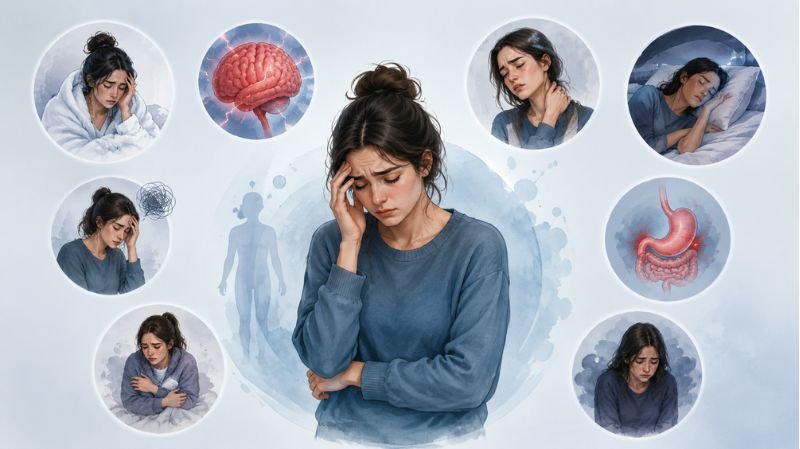
The show is unusually precise about how the Syndrome presents, laying out a six-stage progression on the in-universe warning poster. Understanding these stages helps explain why the condition is treated with such fear and secrecy by the people living in the silo.
Stage 1: Involuntary Twitching
The earliest and most subtle symptom is involuntary twitching. Because it can look like an ordinary nervous habit or a fleeting muscle spasm, this stage is the easiest for someone to hide from friends, family, and coworkers — and it’s exactly the stage where secrecy tends to begin.
Stage 2: Shaking of the Extremities
As the illness progresses, the twitching develops into more pronounced shaking in the hands, arms, and legs. This is the point where the condition becomes harder to conceal in everyday life, particularly in physically demanding jobs like those found in Mechanical.
Stage 3: Pain and Muscle Spasms
Next come flashes of pain accompanied by muscle spasms. This stage marks a shift from a purely cosmetic or inconvenient symptom into something that visibly affects a person’s ability to function and causes real physical suffering.
Stage 4: Balance and Movement Impairment
The fourth stage severely impairs balance and movement, making it increasingly difficult for sufferers to perform their jobs or move safely through the silo’s cramped, spiraling staircases — a detail that carries obvious danger given how central those stairs are to daily silo life.
Stage 5: Cognitive Decline
If left untreated, the poster warns, infection will attack the brain, leading to reduced cognitive function. This is arguably the most frightening stage from a societal standpoint, since it raises the possibility of erratic, unpredictable, or dangerous behavior from someone who may still be walking freely among thousands of other residents.
Stage 6: Nervous System Shutdown
In its final and most severe form, the Syndrome results in a complete shutdown of the entire nervous system. The poster does not spell out what happens after this point, but the implication is grim: without treatment, the condition is ultimately fatal or at least totally incapacitating.
What Causes the Syndrome? Leading Theories

This is the question that has fueled the most fan speculation, and as of the most recent season, Silo still hasn’t handed viewers a definitive answer. Several theories have circulated, some grounded in dialogue from the show itself and others pieced together from context clues.
Theory 1: Vitamin Deficiency
One popular in-universe theory is that the Syndrome stems from a nutritional deficiency, most likely related to vitamin D. Since the entire population of the silo lives underground with no access to natural sunlight, and food is grown artificially rather than under open sky, a long-term deficiency of this kind is biologically plausible. Supporters of this theory point to the fact that symptoms — nerve issues, muscle problems, cognitive decline — overlap with real-world conditions linked to severe vitamin deficiencies.
Theory 2: Blood Disorder
A second theory, also referenced by characters within the show, suggests the Syndrome could be a form of blood disorder. This would help explain why the condition doesn’t appear to be contagious yet still produces such wide-ranging physical effects throughout the body, since blood disorders can influence everything from muscle function to brain activity depending on severity.
Theory 3: A Psychological or “Neuralgic” Response to Confinement
Perhaps the most compelling theory comes directly from the show’s own creative team. Showrunner Graham Yost addressed the Syndrome’s conceptual origins in an interview with SFX Magazine, explaining that he and author Hugh Howey discussed how humans were never designed to live packed into a sealed, underground structure for generations. Yost described the resulting condition as “a neuralgic response to the pressure of living in these conditions.”
That description suggests the Syndrome may not be a straightforward infection or nutritional problem at all, but rather a slow-building physiological reaction to chronic environmental and psychological stress — the human body and nervous system essentially breaking down under conditions they were never meant to endure. Neuralgic conditions in the real world are often connected to long-term nerve damage or chronic strain, which lines up with this theory nicely and adds a layer of tragic inevitability: the Syndrome may simply be the price of surviving underground long enough.
Theory 4: Bacterial Infection Tied to Environmental Exposure
A fourth theory leans on the “clean living” language from the warning poster itself. If cleanliness is presented as a genuine form of prevention, that implies exposure to some kind of pathogen — potentially bacteria present in the silo’s aging, rusted mechanical infrastructure, or in areas with poor air quality. Under this theory, the Syndrome would be a non-contagious bacterial illness that specific residents are simply more likely to encounter based on where they work or live within the silo, which could explain why cases seem to cluster around certain levels or professions.
What the Showrunner Has Said
Beyond the neuralgic-response explanation, Yost has also discussed the emotional and narrative purpose behind creating the Syndrome. He has noted that part of the appeal was building an illness wrapped in uncertainty and stigma — something residents genuinely don’t know the full truth about, whether it’s hereditary, what exactly triggers it, or how to definitively prevent it. That ambiguity mirrors real-world anxieties around chronic and stigmatized illnesses, where sufferers often face shame and exclusion even without full scientific clarity about causes or risk factors. Yost has also indicated that those diagnosed with the Syndrome are barred from activities like carrying weapons or engaging in strenuous physical roles, reinforcing how seriously the silo’s institutions treat the condition once it’s confirmed.
Is the Syndrome Contagious or Genetic?
Based on everything shown so far, the Syndrome does not appear to be contagious. The clearest piece of evidence comes from Deputy Paul Billings, one of the first confirmed cases the audience sees. Billings continues living with his wife and child without isolating himself, and there is no indication in the show that his family faces any additional risk from close contact with him.
It also doesn’t appear to be strictly genetic. Billings’ own wife tells him that their child shows no signs of the illness, suggesting it isn’t simply passed down from parent to child in a predictable hereditary pattern. This detail rules out some possibilities and strengthens the case for an environmental or cumulative-exposure explanation — something that develops over an individual’s lifetime based on factors like age, job assignment, diet, or how long a person has lived underground, rather than something baked into their DNA from birth.
The Syndrome and Silo’s Pact — Article 5
The Syndrome isn’t just a medical concern in the world of Silo — it’s a legal and political one. According to Article 5 of the silo’s founding legal document, known as the Pact, anyone diagnosed with the Syndrome is prohibited from holding public office or any other position of authority. The stated reasoning is public safety: officials argue that someone experiencing symptoms like impaired cognition, shaking hands, or reduced motor control shouldn’t be trusted with responsibilities that affect the wellbeing of the silo’s roughly ten thousand residents.
This rule carries real narrative weight. It transforms a personal medical diagnosis into a career-ending, identity-altering event, which is exactly why characters who contract the Syndrome go to such lengths to hide it. Being outed isn’t just embarrassing; it can mean losing your job, your standing in the community, and potentially your ability to protect yourself or your family.
Deputy Paul Billings: The First Confirmed Case

Deputy Paul Billings is the character who brings the Syndrome into the show’s foreground. When Juliette Nichols, freshly appointed as sheriff, grows frustrated with Billings and questions why she should trust him, she throws his secret in his face — accusing him of concealing his diagnosis while continuing to serve in a position of authority, a direct violation of Article 5.
The show later gives audiences a quieter, more human look at what living with the Syndrome actually looks like day to day. Billings is shown at home with his wife, attempting to manage his symptoms with simple remedies like ginger and cold compresses, rather than seeking the official medical treatment the warning posters urge residents to pursue. That choice says a lot about the culture of fear and shame surrounding the illness — even when help is technically available, the social cost of admitting you need it can feel too high.
Solo and the Heterochromia Connection
Season 2 introduced Steve Zahn’s character Solo (later revealed to be a man named Jimmy), a survivor found living alone in the ruins of Silo 17. Long before his introduction, the Season 2 marketing built noticeable intrigue around one specific physical detail: Solo’s eyes are two different colors, one a vivid blue and the other a duller brown.
Because heterochromia isn’t part of Solo’s description in Howey’s novels, and because the Syndrome itself is also a television-only addition, fans quickly theorized the two details might be connected — that Solo’s mismatched eyes could be a visual marker of long-term, untreated Syndrome, developed after years of isolation in far harsher conditions than the ones Juliette and her fellow Silo 18 residents were used to. While the show has not explicitly confirmed this link on screen, the timing and framing of the reveal make it one of the more widely accepted theories among viewers, and it fits neatly with the idea that prolonged, extreme underground living conditions are what trigger or worsen the illness.
Solo’s backstory, revealed across Season 2, adds further weight to this reading. Having survived alone for years following a devastating rebellion and Safeguard activation in Silo 17, Solo represents an extreme case study in exactly the kind of isolation and deprivation that showrunner Yost described as the Syndrome’s underlying trigger.
The Syndrome’s Symbolic Meaning

Beyond its function as a plot device, the Syndrome operates as a piece of thematic shorthand for everything Silo is trying to say about life under an oppressive, closed system. Humans were not built to live crammed together underground, cut off from sunlight, open air, and the natural world, for generation after generation — and the Syndrome dramatizes that truth literally, turning an abstract idea about confinement into a visible, physical illness.
The way the silo’s institutions respond to the Syndrome reinforces this theme even further. Rather than treating sufferers with compassion, the Pact isolates them professionally, and the surrounding culture treats a diagnosis as something to be ashamed of and hidden. That response mirrors the broader power structure running through the entire show: a rigid hierarchy that prioritizes order, secrecy, and control over honesty and care for its citizens. In that sense, the Syndrome isn’t just something happening to individual characters — it’s a symptom, both literal and figurative, of the silo itself.
The Syndrome vs. the Books: An Original Addition

It’s worth repeating because it surprises a lot of fans who come to the show after reading Hugh Howey’s novels first: the Syndrome does not exist anywhere in the source material. Howey’s original trilogy focuses heavily on the mechanics of silo life, the mystery of the outside world, and the Safeguard Procedure, but it never introduces a comparable illness.
This means book readers don’t have a shortcut to the answer, and it also means the show’s writers have complete creative freedom in deciding how — or whether — to fully resolve what the Syndrome is and where it came from. Yost has described the collaborative process of dreaming the condition up with Howey specifically for the adaptation, framing it as a deliberate addition meant to deepen the show’s exploration of what prolonged underground living does to the human body and mind.
Will We Learn More About the Syndrome in Season 3?

Silo has already been renewed through Season 4, which is expected to serve as the show’s final season, giving the writers ample room to circle back to lingering mysteries like the Syndrome’s true cause. Season 2 expanded the world dramatically, confirming the existence of at least fifty silos and deepening the mythology around the Safeguard Procedure, Solo’s tragic backstory, and the rebellion that destroyed Silo 17.
With that larger picture now in place, and with Solo’s own possible connection to the illness left unconfirmed, there’s a strong likelihood that future seasons will revisit the Syndrome — particularly if the story expands into other silos, where different environmental conditions, different Pacts, or different levels of institutional secrecy could shed new light on what’s really causing it. Given how much attention the show has already paid to setting up the Syndrome’s symptoms, rules, and stigma, it would be a significant missed opportunity for the series to leave the mystery permanently unexplained.
Frequently Asked Questions
Is the Syndrome a real medical condition?
No. The Syndrome is a fictional illness created specifically for Apple TV+’s Silo series. It does not correspond to a single real-world diagnosis, though its symptoms echo real conditions involving nerve damage, vitamin deficiencies, and blood disorders.
Is the Syndrome contagious?
Based on what’s shown in the series, no. Deputy Billings continues living closely with his wife and child without any indication that they are at risk, suggesting the illness isn’t transmitted through everyday contact.
Is the Syndrome genetic or hereditary?
It doesn’t appear to be. Billings’ wife confirms their child shows no symptoms, which points away from a straightforward hereditary cause and toward an environmental or cumulative explanation instead.
What happens if someone is diagnosed with the Syndrome?
Under Article 5 of the Pact, anyone diagnosed with the Syndrome is barred from holding public office or positions of authority. Diagnosed individuals are also encouraged to seek free treatment at any Medical Level, though the show suggests many residents avoid doing so out of fear and stigma.
Who has the Syndrome in Silo?
Deputy Paul Billings is the first character confirmed to have the Syndrome, revealed in Season 1. Season 2 has fueled strong fan speculation that Solo may also be affected, based on his heterochromia and history of prolonged isolation, though this has not been officially confirmed by the show.
Does the show ever explain what causes the Syndrome?
Not definitively, at least not through Season 2. The series has offered several competing theories through dialogue and visual clues — vitamin deficiency, blood disorder, bacterial infection, and a stress-related neuralgic response — without settling on one official explanation.
Conclusion
The Syndrome remains one of Silo’s most quietly unsettling mysteries: an illness that feels less like a plot twist waiting to be solved and more like a slow-burning metaphor for what it costs to survive in a world stripped of sunlight, freedom, and honesty. Whether it turns out to be rooted in nutrition, genetics, infection, or the simple, cumulative toll of confinement, the Syndrome has already done its job as a storytelling device — reminding viewers that the silo’s greatest threats aren’t always the ones lurking outside its walls. As Silo moves toward its final chapters, fans will be watching closely to see whether the show finally pulls back the curtain on what, exactly, is breaking its people down from the inside.