Amanda Walker
Imagine loading a game where the city around you breathes — traffic responds to a thunderstorm, NPCs argue in a café based on that morning’s in-game news, and a building you blew up three sessions ago is still a smoldering ruin. No loading screens. No pop-in. No compromise between scale and detail.
That’s not science fiction. That’s the direction Unreal Engine 6 appears to be heading.
For over two decades, Epic Games’ Unreal Engine has been the backbone of modern game development. But while Unreal Engine 5 already felt like a leap into the future — with photorealistic geometry, dynamic global illumination, and near-cinematic digital humans — developers and technologists are now asking: what comes next?
Unreal Engine 6 has not been officially announced as of 2025, but the signals are everywhere — in patent filings, conference talks, Epic’s corporate roadmap, and Tim Sweeney’s increasingly bold public statements about the future of real-time simulation. This article breaks down everything currently known, credibly speculated, and technically expected about Unreal Engine 6 — including what problems it needs to solve, what new ground it may break, and why it matters far beyond gaming.
A Quick History: How We Got Here
Understanding where Unreal Engine 6 is going requires knowing what each generation actually solved.
UE1–UE3: Building the Foundation (1998–2012)
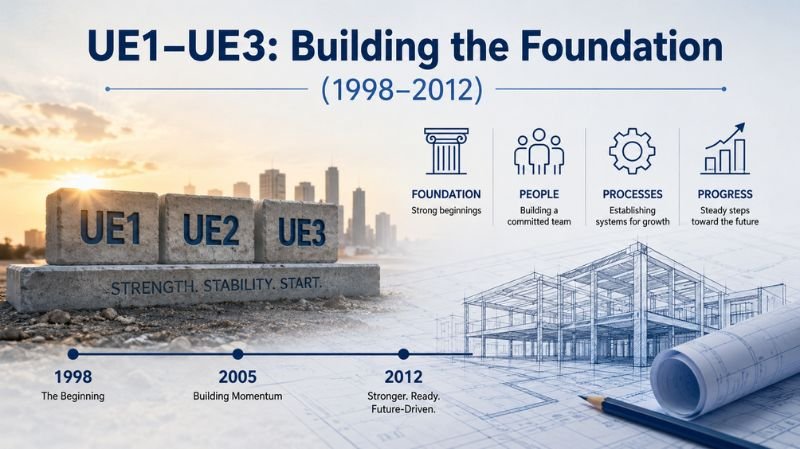
The original Unreal Engine powered the 1998 shooter Unreal and quickly set a standard for 3D environments. UE3, released during the PS3/Xbox 360 era, became the go-to engine for blockbusters like Gears of War, Mass Effect, and Batman: Arkham Asylum. Its strength was scalability — studios of very different sizes could build polished, commercially viable games on it.
UE4: Democratization (2014–2021)

UE4’s biggest revolution wasn’t graphical — it was philosophical. Epic dropped licensing fees, introduced Blueprint visual scripting (letting non-programmers build game logic), and launched a marketplace ecosystem. Suddenly, a two-person indie team could access the same engine as a 500-person AAA studio. This shift permanently changed who gets to make games.
UE5: The Photorealism Leap (2022–Present)

UE5 introduced two systems that genuinely changed the industry:
- Nanite — Virtualized geometry that lets developers import film-quality assets (literally billions of polygons) without manual optimization. A cliff face sculpted in ZBrush can drop straight into a game.
- Lumen — Fully dynamic global illumination. Lights, reflections, and shadows respond to the world in real time, without baking or pre-calculation.
Combined with World Partition (for massive open worlds) and MetaHuman Creator (for photorealistic digital humans), UE5 collapsed the gap between cinematic CGI and real-time gameplay.
But UE5 also revealed new limitations — and those limitations are exactly what Unreal Engine 6 will likely be designed to solve.
The Problem with UE5: What Still Needs Fixing

Before we speculate about Unreal Engine 6, it’s worth being honest about where UE5 struggles:
Performance overhead is brutal. Nanite and Lumen are extraordinary, but running both at high settings on mid-range hardware is genuinely challenging. Many studios ship games with Lumen disabled or heavily scaled back.
Large multiplayer worlds remain hard. UE5’s networking tools are powerful, but building persistent online worlds with thousands of simultaneous players still requires enormous engineering effort outside the engine itself.
AI-driven NPC behavior is limited. Characters in UE5 games can look photorealistic but often behave with 2005-era intelligence. The engine has no built-in framework for truly emergent, believable AI behavior.
Iteration speed is slow for large teams. Compiling shaders, loading massive levels, and managing complex Blueprint hierarchies can grind large productions to a halt.
These aren’t minor complaints — they’re the bottlenecks costing studios millions of dollars and years of development time. Unreal Engine 6 needs to address all of them.
What We Expect from Unreal Engine 6
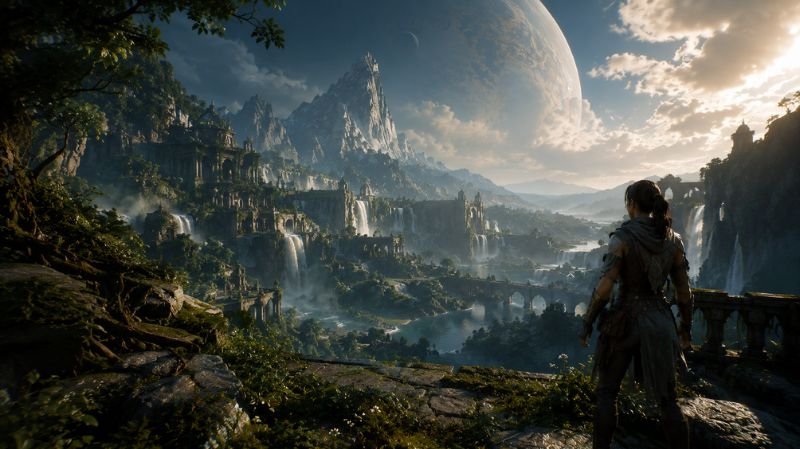
1. AI-Assisted Development: The End of Grunt Work
The most transformative change in Unreal Engine 6 may not be visible to players at all — it’ll be what happens in the editor.
Epic has already begun integrating AI tools into its pipeline. The logical extension of this is an engine where a designer can describe what they want rather than always manually building it. Imagine typing: “Generate a dense favela neighborhood, late afternoon light, with roughly 200 inhabitants going about daily routines” — and watching the engine assemble it.
Expected AI features include:
- AI-assisted level design — Generating environments from natural language prompts, with the developer refining rather than building from scratch
- Intelligent bug detection — Real-time analysis that flags performance issues, broken logic, or inconsistencies as you build, not after a 4-hour compile
- Procedural NPC behavior — NPCs with believable goals, memories, and reactions, generated and managed at scale without hand-scripting every interaction
- Automated animation retargeting — Motion captured from one body type adapts intelligently to any character, rather than requiring laborious manual adjustment
The goal isn’t to replace developers. It’s to eliminate the most tedious, time-consuming parts of their work so they can focus on the 20% that actually requires human creativity.
2. Neural Rendering: When AI Does the Drawing
Current rendering works by calculating every light ray, every surface interaction, every shadow mathematically — an enormously expensive process. Neural rendering takes a fundamentally different approach: it uses trained AI models to predict how a scene should look, filling in detail without brute-force calculation.
NVIDIA’s DLSS and Intel’s XeSS are early glimpses of this. Unreal Engine 6 is expected to bake neural rendering far deeper into the pipeline, enabling:
- Path-traced visuals at real-time frame rates — The gold standard of photorealism, previously only achievable in offline rendering
- AI-generated geometry detail — Surfaces and textures that grow sharper at close range because the engine infers detail rather than storing it all at once
- Predictive lighting — Global illumination that updates based on learned scene patterns rather than recalculating from scratch every frame
For players, this means games that look like pre-rendered cinematics while they’re playing them. For developers, it means realism that no longer requires impossible hardware specs.
3. Planet-Scale Worlds That Actually Live
UE5’s World Partition system let developers build bigger maps. Unreal Engine 6 may let them build living planets.
The distinction matters. A big map is just more terrain. A living world is one where an ecosystem functions whether or not the player is watching — forests regenerate after fires, cities respond to economic pressures, weather systems move with physical accuracy across a continent.
Expected world-building advancements:
- Persistent simulated ecosystems — Wildlife populations, vegetation cycles, and environmental changes that evolve in real time
- Dynamic urban simulation — Cities with functioning traffic, economic systems, and population behavior, not just set-dressing
- Geological-scale terrain — Procedurally generated worlds at resolutions that would make current open-world games look like demo levels
- True destructibility — Environments that don’t just play destruction animations but actually structurally collapse, with debris that persists and affects gameplay
Games like Red Dead Redemption 2 showed what believable world systems can do for immersion. UE6 could make that level of simulation the default, not the exception.
4. Multiplayer at Civilizational Scale
Epic runs Fortnite — one of the most complex real-time online systems ever built, with millions of concurrent players across thousands of simultaneous game instances. That infrastructure knowledge is almost certainly feeding into Unreal Engine 6 networking architecture.
The goal for Unreal Engine 6 multiplayer appears to be persistent, massive shared worlds — not lobbies and match instances, but ongoing environments where thousands of players coexist and their actions have lasting consequences.
Key improvements expected:
- Cloud-native world persistence — Game state stored and processed in the cloud, so the world evolves even when individual players are offline
- Dramatically reduced latency — Predictive networking that compensates for connection delays, making even intercontinental play feel local
- Cross-platform identity — A unified player presence that works across PC, console, mobile, and VR without developers building separate systems
This is the foundation infrastructure for what many call the metaverse — though the more grounded description is simply: the internet, but as a place you move through rather than pages you visit.
5. MetaHumans That Feel Alive
Current MetaHuman characters look extraordinary. But they act like puppets — beautiful, expressive puppets, but still ultimately driven by pre-authored animation.
UE6 is expected to give these characters something closer to genuine behavioral intelligence:
- Real-time emotional modeling — Characters whose facial expressions and body language respond dynamically to conversation and context, not just pre-set emotional states
- AI-driven dialogue — NPCs that can hold contextually coherent conversations rather than cycling through scripted lines
- Procedural performance capture — Generate realistic character performances from text descriptions, dramatically cutting the cost of dialogue production
The downstream impact of this extends well beyond gaming. Realistic, behaviorally intelligent digital humans have transformative applications in film, education, therapy, customer service, and medical training.
UE6 Beyond Gaming: Industries Already Watching
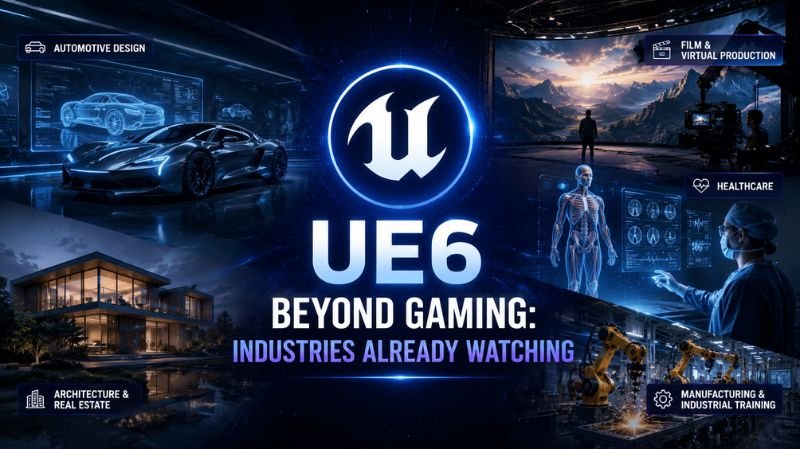
Film & Television
The shift to virtual production — pioneered by The Mandalorian and its massive LED volume stage — is accelerating. Directors no longer need to shoot on location or rely entirely on green screen; they step into a real-time rendered environment that responds to camera movement and lighting in real time. Unreal Engine 6 rendering improvements could make virtual production indistinguishable from live-action photography.
Architecture & Urban Planning
Architects and city planners already use Unreal Engine 6 to walk clients through buildings before a foundation is poured. Unreal Engine 6 could enable full urban-scale simulations — test how a new transit line affects foot traffic, visualize a neighborhood renovation with accurate sun angles throughout the year, or let residents experience a proposed development before approval.
Automotive & Defense Simulation
Car manufacturers use Unreal Engine for digital showrooms and interface prototyping. Defense contractors use it for training simulations. As rendering fidelity and physics accuracy improve, the line between simulation and physical testing blurs — with enormous implications for cost and safety.
Medical Training
Surgical simulators built on Unreal Engine already exist. Unreal Engine 6 improved physics — particularly soft-body simulation and fluid dynamics — could make these simulations genuinely indistinguishable from practicing on real tissue, with AI-driven patient responses that create unpredictable, realistic scenarios.
The Hardware Problem: Will Anyone Be Able to Run It?
Here’s the uncomfortable question: if Unreal Engine 6 achieves everything described above, what kind of hardware does it require?
This is a genuine tension. Pushing rendering fidelity and simulation complexity costs processing power. But games only succeed if people can play them.
Epic’s likely answer is a two-pronged approach:
Scalable quality tiers. Like UE5’s current Scalability settings, Unreal Engine 6 will almost certainly offer configurations that scale from high-end PCs to mid-range laptops and consoles — disabling or simplifying the most demanding features while keeping the core experience intact.
Cloud offloading. For the most computationally intense simulations — complex physics, large-scale AI behavior, detailed world state — Unreal Engine 6 may increasingly offload processing to cloud servers. The local device renders what you see; the cloud handles what the world is doing behind the scenes. This is already how some MMOs manage server-side simulation, and Unreal Engine 6 could make it far more sophisticated.
The catch: cloud dependency means internet dependency. Latency, server costs, and access inequality all become design constraints that Epic will have to take seriously.
UE6 vs. Unity: The Competitive Landscape
Unity’s turbulent 2023 — when its controversial runtime fee announcement triggered a mass developer exodus — significantly shifted the competitive balance. Many studios that had been Unity-first began evaluating Unreal Engine as their primary platform.
UE6 arrives in a landscape where Epic has a genuine opportunity to consolidate its position not just at the AAA level but across the full spectrum of game development. If Epic can keep Unreal Engine 6 accessible to smaller studios (as UE4 was), while offering the technical ceiling that only large studios currently need, the competitive case becomes very strong.
Unity still has real advantages: a larger mobile gaming footprint, arguably gentler learning curves for beginners, and a developer community that didn’t entirely abandon it. But UE6’s trajectory — particularly the AI-assisted development tools — could dramatically reduce the expertise gap that currently makes Unreal intimidating for smaller teams.
When Will Unreal Engine 6 Actually Arrive?
Epic hasn’t announced a release timeline. Based on historical patterns — UE4 launched in 2014, UE5 in 2022 — and the scope of expected changes, a reasonable estimate puts Unreal Engine 6 public release somewhere in the 2027–2030 window, possibly preceded by developer previews in 2026.
The more likely scenario is that UE6 won’t arrive as a single dramatic launch but as a gradual evolution — features rolling into UE5.x updates until the cumulative changes constitute a new generation. Epic has shown a preference for this approach with UE5, which has added significant capabilities through point releases.
What This Means for Developers Today
If you’re building games or real-time experiences right now, UE6’s trajectory should inform your decisions:
- Invest in learning UE5’s advanced features — Nanite, Lumen, PCG — because Unreal Engine 6 will almost certainly extend rather than replace these systems
- Pay attention to Epic’s AI tool releases — The Verse scripting language, MetaHuman Animator, and procedural content generation are the early versions of what will become UE6’s AI pipeline
- Think in systems, not scenes — The shift toward living worlds means design skills focused on systemic behavior (ecosystems, economies, social dynamics) will become increasingly valuable
- Watch the cloud rendering developments — Studios that build expertise in hybrid local/cloud workflows now will have a significant advantage when UE6 makes these approaches standard
Conclusion: A Platform, Not Just an Engine
Unreal Engine 6 represents something more significant than a graphical upgrade. It’s the next phase of Epic’s long-term vision: a universal real-time creation platform that powers not just games but films, architecture, medicine, simulation, and whatever interactive medium comes next.
The most exciting possibility isn’t any single feature on the list above. It’s what happens when AI-assisted creation, photorealistic rendering, living world simulation, and massive multiplayer infrastructure all arrive in the same toolkit — and creative people who couldn’t previously afford or access these tools get to use them.
The game industry didn’t just change when Unreal Engine 5 arrived. It changed when the tools became accessible enough that the question shifted from “Can we build this?” to “What should we build?”
Unreal Engine 6 appears designed to ask that question on behalf of an entirely new generation of creators.