Amanda Walker
Picture this: you are down to the very last clue on a Sunday crossword. The grid needs six letters. The clue says simply “Naval fleet.” You know the answer is somewhere in your memory, but the clock is ticking and the coffee is going cold. Sound familiar?
You are almost certainly looking for ARMADA — a six-letter word that turns up more often than any other answer for naval fleet clues in major crossword databases. But the story behind that word, and the handful of alternate answers that sometimes replace it, is far richer than most guides let on.
This complete guide covers the primary answer, every credible alternative, the historical drama that made ARMADA a crossword favourite, the etymology of the word itself, how the clue works in cryptic puzzles, and a full FAQ section so you can solve any variation of this clue with confidence.
Quick Answer: The Most Common Solution
For most crossword puzzles, the answer to “naval fleet” is ARMADA. It is six letters long (A-R-M-A-D-A), widely recognised, and directly defined as a large fleet of warships in every major English dictionary.
If your grid has six blank squares and the clue is any variation of “naval fleet,” “fighting fleet,” “fleet of warships,” or “historic fleet,” start with ARMADA. The crossing letters will confirm it quickly.
| Solver’s Shortcut:
Six letters + naval theme = ARMADA almost every time. Verify with crossing letters, then move on. The answer is rarely a surprise once you know it. |
The Spanish Armada — Why This Word Dominates Crossword Grids
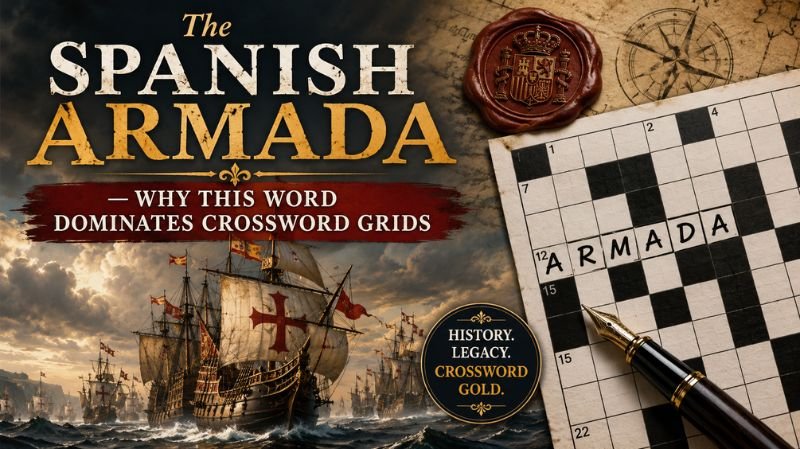
ARMADA is not just a dictionary entry. It carries more than four centuries of history, and understanding that history makes the answer unforgettable.
The Fleet That Changed History
In the summer of 1588, King Philip II of Spain assembled the largest naval force the Western world had ever seen. One hundred and thirty warships, carrying roughly 30,000 men, set sail from Lisbon with one objective: overthrow Queen Elizabeth I of England and return the country to Catholicism. Philip called it the Gran y Felicisima Armada — the Great and Most Fortunate Fleet. History would prove the name bitterly ironic.
The English were outnumbered in ships but not in speed or tactical ingenuity. Lord Howard of Effingham commanded the English fleet, with the legendary Sir Francis Drake as his vice admiral. The two fleets clashed in a series of running battles along the English Channel. Neither side won a decisive early engagement, but the English used a devastating tactic that proved decisive: fire ships.
On the night of 7 August 1588, the English loaded eight vessels with flammable material and set them ablaze, steering them directly into the Spanish formation anchored off Calais. The Spanish fleet, unable to coordinate a response, scattered in panic. The following battle at Gravelines on 8 August was a rout. The Spanish were forced to abandon their invasion plan and attempt to return home by sailing north around Scotland and Ireland — a journey that proved catastrophic.
Brutal North Atlantic storms wrecked dozens of ships on the rocky Irish coastline. Of the 130 ships that had departed Lisbon with such ambition, fewer than 70 limped back to Spain. Philip reportedly received the news with the words: “I sent the Armada to fight against men, not God’s winds and waves.”
The defeat of the Spanish Armada reshaped the balance of European power. It cemented England’s rise as a naval force, emboldened Protestant nations across Europe, and began the slow decline of Spanish dominance at sea. No wonder crossword setters have never tired of the word.
Why Crossword Constructors Love ARMADA
ARMADA earns its crossword dominance for several reasons beyond history. The word has a beautifully balanced letter pattern: A-R-M-A-D-A. It begins and ends with A, contains no double letters, and features no awkward consonant clusters. The letters R, M, and D are medium-frequency in English, which means they appear in enough other words to create natural crossing possibilities in a grid.
Constructors also value its clue flexibility. ARMADA can be clued as a historical reference (“1588 fleet”), a definition (“fleet of warships”), a fill-in-the-blank (“Spanish _”), or even a wordplay element. That versatility makes it one of the most reliably useful six-letter entries in the constructor’s toolkit.
What Does ‘Armada’ Mean? Etymology and Origins
The word armada entered English directly from Spanish in the 16th century, brought into common use precisely because of the 1588 fleet. But its roots are far older.
The Spanish armada derives from the Medieval Latin armata, meaning “armed force” or “equipped fleet.” That Latin word comes from armare, “to arm,” and ultimately from arma meaning “arms” or “weapons.” The same root gives English a remarkable family of words:
- army — from Old French armée, itself from Latin armata
- armour — protective equipment for arms and body
- arms — weapons, and by extension a coat of arms
- armament — the weapons or military equipment of a force
- armistice — a cessation of arms, i.e. a truce
- disarm — to remove arms or weapons
When English speakers began using “armada” after 1588, they were borrowing a Spanish word that already meant exactly what it still means today: a large, armed fleet. The word has changed remarkably little across five centuries and three languages.
For crossword enthusiasts — who tend to be passionate about language — this etymological depth adds extra satisfaction to the solve. ARMADA is not just a six-letter answer; it is a linguistic fossil connecting modern English to the Roman legions.
All Possible Answers by Letter Count
“Naval fleet” is not always a six-letter answer. Different crossword publications, grid sizes, and clue phrasings can shift the expected answer. Use the letter count from your grid first, then confirm with crossing letters.
| Answer | Letters | When it fits | Notes |
| ARMADA | 6 | Most standard crosswords | Default answer; historical and dictionary definition |
| FLEET | 5 | Shorter grids, general clues | Rarely used when ‘fleet’ appears in the clue itself |
| NAVY | 4 | Short grids, broad naval clues | More institutional than fleet-specific |
| SHIP | 4 | Part-of-a-fleet clues | Singular; clue usually says ‘part of’ or ‘fleet unit’ |
| VESSELS | 7 | Longer grids, informal clues | Broader term; covers civilian and military ships |
| WARSHIPS | 8 | Military-specific, longer grids | Literal; best for ‘fighting fleet’ clue wording |
| FLOTILLA | 8 | Smaller fleet references | Technically a smaller fleet or fleet of smaller ships |
| SQUADRON | 8 | Military formation clues | A sub-unit of a larger fleet |
How to Use This Table
Always start by counting the blank squares in your grid. If the answer is 6 letters, ARMADA is your working hypothesis. Fill in any confirmed crossing letters and check whether they are consistent. A confirmed R in the second position and A at the start makes ARMADA virtually certain.
If the answer is not 6 letters, move down the table. An 8-letter answer for a military clue is almost always WARSHIPS or FLOTILLA, and crossing letters will distinguish them quickly.
Clue Phrasing to Answer Mapping
| Clue Phrasing | Most Likely Answer | Letters |
| Naval fleet | ARMADA | 6 |
| Historic naval fleet | ARMADA | 6 |
| Spanish ___ | ARMADA | 6 |
| 1588 fleet | ARMADA | 6 |
| Fleet of warships | ARMADA | 6 |
| Military fleet | ARMADA / WARSHIPS | 6 or 8 |
| Large fleet | ARMADA | 6 |
| Fighting ships | WARSHIPS | 8 |
| Small fleet | FLOTILLA | 8 |
| Fleet formation | SQUADRON | 8 |
| Part of a naval fleet | SHIP | 4 |
| Naval force (broad) | NAVY | 4 |
| Ships in a fleet (informal) | VESSELS | 7 |
| Group of ships | FLEET | 5 |
How to Solve Naval Fleet Clues Faster
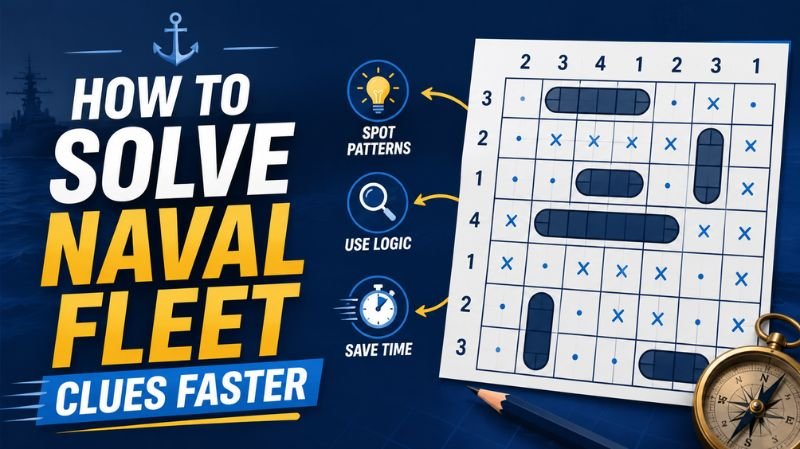
Even experienced solvers occasionally pause on “naval fleet” clues. The following method will help you work through any variation in under a minute.
Step 1 — Count the Letters
Before doing anything else, count the blank squares. The number alone eliminates most possibilities. Six letters points to ARMADA with high confidence. Eight letters most likely means WARSHIPS or FLOTILLA.
Step 2 — Check Crossing Letters
Even one confirmed letter dramatically narrows your options. An A in the first position combined with a six-letter count makes ARMADA almost certain. An F in the first position of an eight-letter answer points to FLOTILLA rather than WARSHIPS.
Step 3 — Read the Clue Tone
Is the clue historical? (“1588 fleet”, “Spanish ___”) — go straight to ARMADA. Is it literal and military? (“Fighting ships”) — consider WARSHIPS. Is it general? (“Group of ships”) — consider FLEET. The tone of the clue almost always gives the setter’s intent away.
Step 4 — Note the Publication
Different crossword publications have different conventions. The New York Times crossword tends toward clean, unambiguous clues where ARMADA almost always works for six-letter naval entries. The LA Times crossword follows similar conventions. British crosswords — particularly the Guardian and the Daily Telegraph — sometimes use ARMADA in cryptic constructions that look very different from a straightforward definition clue. The Times of London cryptic is the most demanding and may embed ARMADA in complex wordplay.
Knowing which publication you are solving tells you how literally to interpret the clue. A Monday NYT “naval fleet” is almost certainly a direct definition. A Thursday Times cryptic could be anything.
Cryptic Crossword Variations
If you are solving a cryptic crossword — common in the UK and among advanced puzzlers worldwide — “naval fleet” operates very differently from a straight definition clue. Understanding this difference is the key to solving cryptic variants with confidence.
How Cryptic Clues Work
Every cryptic clue has two parts: a definition and a wordplay indicator. The definition is usually at the beginning or end of the clue and is a genuine synonym or description of the answer. The wordplay is in the middle and encodes the answer through a mechanical operation such as an anagram, a hidden word, a reversal, or a combination of sounds.
The solver’s job is to identify where the definition ends and the wordplay begins — which is often deliberately disguised.
ARMADA in Cryptic Constructions
Here are three examples of how ARMADA might appear in a cryptic clue, with explanations:
| Example 1 — Anagram:
“Naval fleet in mad drama (6)” — ‘mad drama’ is an anagram indicator and the letters to scramble (M-A-D-D-R-A-M-A minus the extra M = A-R-M-A-D-A). ‘Naval fleet’ is the definition. |
| Example 2 — Hidden Word:
“Naval fleet concealed in charm admiral (6)” — the answer is hidden inside the letters: ch-ARMADA-miral. ‘Concealed in’ signals a hidden word. ‘Naval fleet’ is the definition. |
| Example 3 — Charade:
“ARM + A + DA = naval fleet (6)” — ‘arm’ (weapon), ‘a’ (article), ‘da’ (slang for father or yes) combine to spell ARMADA. ‘Naval fleet’ confirms the definition. |
Where Cryptic Crosswords Are Found
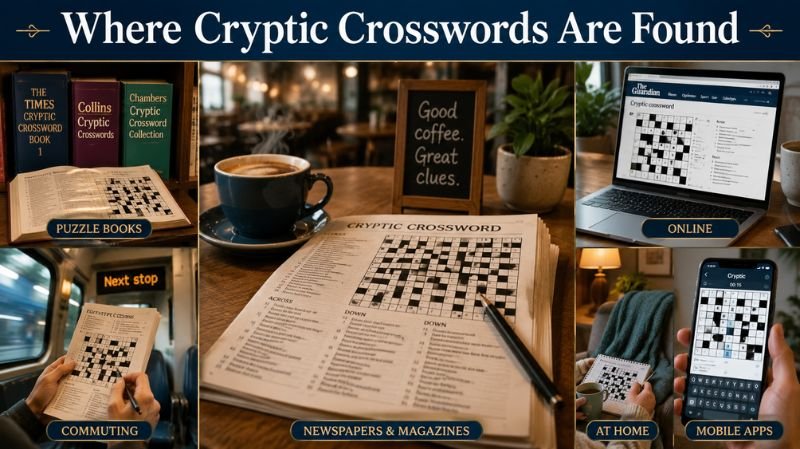
Cryptic crosswords are most common in British newspapers. The Guardian cryptic is considered approachable for beginners. The Daily Telegraph cryptic is reliable and consistent. The Times cryptic is the gold standard of difficulty in the UK. The Spectator and The Listener (published in The Times) are for advanced solvers only. In the United States, cryptics appear occasionally in The Atlantic and in specialist publications such as The Enigma.
If your clue has a playful, slightly odd phrasing that does not read as a clean definition, you are almost certainly dealing with a cryptic clue. Look for the definition at one end of the clue and trust that the remaining words are the wordplay mechanism.
Related Naval Crossword Terms to Know
Knowing the broader vocabulary around naval fleets will help you solve clues that are phrased differently from the standard “naval fleet” entry. The following terms are all crossword-common and regularly appear in naval-themed puzzles.
FLOTILLA — 8 Letters
A flotilla is technically a fleet of small ships, or a small fleet. The word comes from Spanish flotilla, a diminutive of flota (fleet). In crosswords, it appears for clues like “small naval fleet,” “destroyer group,” or “fleet of smaller vessels.” Its distinctive letter pattern — F-L-O-T-I-L-L-A — with a double L makes it easy to confirm from crossing letters.
SQUADRON — 8 Letters
A squadron is a naval formation: a subdivision of a fleet, typically consisting of two or more divisions. The word derives from the Italian squadrone (a large square formation of troops). In crosswords it appears for “fleet unit,” “naval formation,” or “air force group.” Note that squadron also applies to air forces, so context matters.
GALLEON — 7 Letters
A galleon was a large, multi-decked sailing ship used primarily by European powers from the 15th through 18th centuries. The Spanish Armada was largely composed of galleons. In crosswords, “galleon” appears for clues like “Spanish warship,” “treasure ship,” “Drake’s quarry,” or “Armada vessel.” Seven letters, starts with G.
FRIGATE — 7 Letters
A frigate is a type of warship, historically fast and lightly armed compared to a ship of the line. The word comes from French fregate and Italian fregata. In crosswords: “fast warship,” “naval escort,” “man-of-war.” Seven letters, starts with F.
MAN-OF-WAR — 9 Letters (with hyphen)
A man-of-war was the general term for a large sailing warship in the age of sail. It occasionally appears in British cryptic crosswords as a compound answer. More commonly, it appears as a clue indicator for BATTLESHIP or WARSHIP.
| Term | Letters | Meaning | Typical Clue Phrasing |
| ARMADA | 6 | Large fleet of warships | Naval fleet, Spanish fleet, historic fleet |
| FLEET | 5 | Group of ships | Naval group, shipping force |
| FLOTILLA | 8 | Small fleet / fleet of small ships | Small naval fleet, destroyer group |
| SQUADRON | 8 | Fleet subdivision | Naval formation, fleet unit |
| GALLEON | 7 | Large sailing warship | Spanish warship, treasure ship, Drake’s target |
| FRIGATE | 7 | Fast warship | Naval escort, fast warship, man-of-war type |
| CORVETTE | 8 | Small warship | Small warship, NATO ship type |
| DREADNOUGHT | 10 | Heavily armoured battleship | WWI battleship, naval giant |
Frequently Asked Questions
What is the most common crossword answer for “naval fleet”?
ARMADA (6 letters) is by far the most frequent answer for “naval fleet” in crossword puzzles. It appears in the New York Times, LA Times, Guardian, Telegraph, and most other major crossword databases. When in doubt and the answer is six letters, ARMADA is the right starting point.
How many letters are in ARMADA?
Six letters: A-R-M-A-D-A. The word begins and ends with A, which often makes it easy to confirm from crossing letters — if you have an A in the first or sixth position of a six-letter naval clue, ARMADA becomes the obvious candidate immediately.
What was the Spanish Armada?
The Spanish Armada was a fleet of 130 warships assembled by King Philip II of Spain in 1588 with the intention of invading England and overthhrowing Queen Elizabeth I. It was defeated by a combination of English naval tactics and severe North Atlantic storms, with fewer than 70 ships returning to Spain. The event reshaped European power and cemented England’s status as a major naval force.
What does the word ‘armada’ mean?
Armada comes from Spanish and Medieval Latin, meaning “armed fleet” or “armed force.” The root is the Latin arma (arms, weapons), the same root that gives English army, armour, armament, and armistice. The word entered English in the 16th century specifically because of the 1588 Spanish fleet.
Can FLEET be the answer to a “naval fleet” clue?
Rarely. Crossword constructors generally avoid answers that repeat a word from the clue itself — using FLEET to answer “naval fleet” would be considered poor construction. If FLEET appears in the grid, the clue will usually be phrased differently, such as “group of ships,” “navy’s vessels,” or “convoy.”
What is the difference between an armada and a flotilla?
An armada refers to a large, powerful fleet of warships — the term carries a sense of scale and military might. A flotilla is a smaller fleet, usually of smaller vessels. If your crossword grid needs 8 letters and the clue says “small fleet,” FLOTILLA is far more likely than ARMADA.
What if my answer does not match any in the table above?
First, re-count the blank squares — it is easy to miscount under pressure. Then check your crossing letters carefully. If you are confident in the letter count and two or three crossing letters are confirmed, check whether the clue is cryptic. Cryptic clues require a different approach: identify the definition component (usually at one end of the clue) and treat the remaining words as wordplay. If you are still stuck, consider whether the clue is from a themed puzzle where the setter may be using a less common term.
Are there any other six-letter answers for naval fleet?
ARMADA is by far the most common, but in very rare cases you might encounter CONVOY (7 letters, usually civilian), PATROL (6 letters, but not specifically a fleet), or in older British puzzles, ARMADA variants. If crossing letters rule out ARMADA definitively, revisit the clue wording — the setter may be using a metaphorical or thematic definition rather than a direct naval term.
The Practical Takeaway
For the vast majority of crossword puzzles — American, British, or otherwise — ARMADA is the answer when the clue says “naval fleet.” It is six letters long, it has a clean letter pattern that plays well in grids, and it carries a historical resonance that crossword constructors find irresistible.
When ARMADA does not fit, work through the alternatives systematically: count the letters, check the clue tone, use crossing letters to confirm. The extended vocabulary table in this guide covers every credible alternative you are likely to encounter across major crossword publications.
And if you have time after filling in the answer, spare a thought for the 30,000 sailors who set out from Lisbon in the summer of 1588 aboard the fleet that made the word famous. ARMADA is a small word for a very large piece of history.