Amanda Walker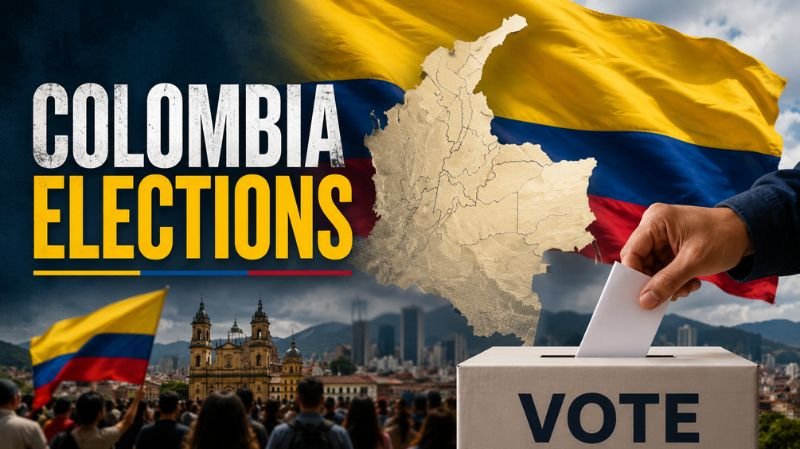
Colombia’s elections rank among the most consequential democratic events in Latin America. As a country that has navigated more than five decades of armed conflict, deep economic inequality, and sweeping institutional reform, each election cycle is not merely a political exercise — it is a national referendum on what kind of country Colombia wants to become.
The 2022 presidential election underscored this transformation dramatically. Gustavo Petro — a former M-19 guerrilla member and long-time senator — became Colombia’s first left-wing president, defeating businessman Rodolfo Hernández with 50.4% of the vote in the second round. Francia Márquez, an Afro-Colombian environmental activist, became Vice President — a historic first on two counts.
This guide covers Colombia’s electoral structure, historical evolution, major parties and figures, recent election results with data, key voter issues, and what to expect heading toward the 2026 elections.
1. Colombia’s Electoral System Explained
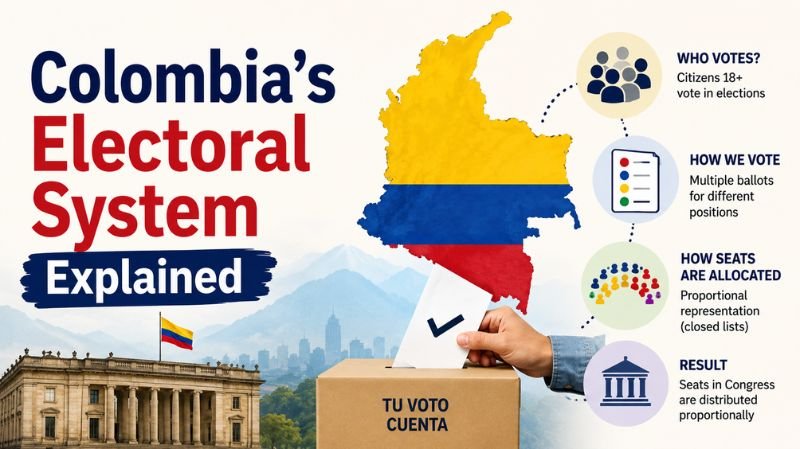
Colombia operates as a presidential republic with a two-round electoral system.
Presidential Elections
- The President serves a four-year term as both head of state and head of government.
- Immediate consecutive re-election is prohibited under the 2015 constitutional reform.
- A candidate must receive more than 50% of valid votes in Round 1 to win outright.
- If no candidate clears 50%, the top two advance to a second round (runoff) held three weeks later.
- Elections are overseen by the National Civil Registry (Registraduría Nacional del Estado Civil).
Congress (Two Chambers)
- Senate (Cámara Alta): 108 seats elected nationally by proportional representation, including 5 reserved for former FARC combatants under the 2016 peace deal.
- House of Representatives (Cámara de Representantes): 188 seats, elected from regional departments and special constituencies including Afro-Colombian, indigenous, and diaspora communities.
- Congressional elections are held simultaneously with the first round of presidential elections every four years.
Local and Regional Elections
Every four years, Colombians also elect governors, mayors, departmental assemblies, and municipal councils in a separate local election cycle. The last local elections took place in October 2023.
| Key Term: A consulta popular (popular consultation) allows parties to hold open primaries. In 2022, the Historic Pact used this mechanism to choose Gustavo Petro as its presidential candidate. |
2. Historical Background
La Violencia (1948–1958)
Colombian politics for most of the 20th century was dominated by two parties: the Liberal Party and the Conservative Party. Their rivalry sparked one of the bloodiest periods in Latin American history — La Violencia — triggered by the assassination of Liberal leader Jorge Eliécer Gaitán in Bogotá on April 9, 1948. Estimates suggest between 200,000 and 300,000 Colombians died in the ensuing decade of partisan bloodshed.
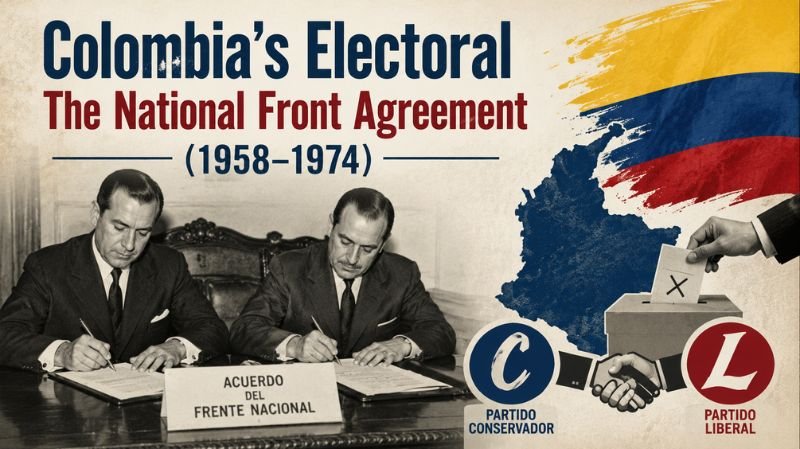
The National Front Agreement (1958–1974)
To end partisan violence, the two parties signed the National Front pact, under which Liberals and Conservatives agreed to alternate the presidency and share all cabinet posts equally. While this stabilized the country, it locked out emerging political movements and contributed to the conditions that spawned guerrilla groups in the 1960s.
The 1991 Constitution: A Democratic Reset
Drafted by a constituent assembly that included former M-19 guerrillas, indigenous delegates, and youth representatives, Colombia’s 1991 Constitution is widely considered one of the region’s most progressive. Key democratic reforms included:
- Multi-party electoral competition (ending the Liberal-Conservative duopoly).
- Direct election of governors and mayors for the first time.
- New citizen participation mechanisms including the tutela (judicial protection writ).
- Enhanced protection for minority rights and indigenous communities.
- An independent Constitutional Court to review legislation.
The FARC Era and Peace Negotiations
From the 1960s through the 2010s, the Revolutionary Armed Forces of Colombia (FARC-EP) waged a Marxist insurgency that displaced over 7 million people — making Colombia one of the world’s largest internal displacement crises. The conflict also intersected with drug trafficking, paramilitary violence, and systemic corruption.
President Juan Manuel Santos launched formal peace negotiations with FARC in Havana, Cuba in 2012. The resulting 2016 Peace Accord was rejected in a surprise referendum (50.2% against) in October 2016 — but renegotiated and ratified by Congress two months later. Santos received the Nobel Peace Prize that same year. Implementation of the accord — including rural reform, transitional justice, and reintegration of combatants — remains contested and incomplete as of 2025.
3. Recent Presidential Election Results (2010–2022)
The table below summarizes Colombian presidential election outcomes over the past four cycles:
| Year | Candidate (Winner) | Party / Coalition | 1st Round % | Winner |
| 2010 | Juan Manuel Santos | Party of the U | 46.7% | Yes (R2) |
| 2014 | Juan Manuel Santos (re-elect) | Party of the U | 25.7% | Yes (R2) |
| 2018 | Iván Duque | Democratic Center | 39.1% | Yes (R2) |
| 2022 | Gustavo Petro | Historic Pact | 40.3% | Yes (R2) |
Note: R2 = Won in second-round runoff. All four elections since 2010 required a second round.
Voter Turnout by Election
Turnout has risen significantly since 2014, driven by heightened political polarization and the emergence of new political forces:
| Year | Round 1 Turnout | Round 2 Turnout | Notable Context |
| 2010 | 49.3% | 44.3% | Santos vs. Mockus runoff |
| 2014 | 40.0% | 47.8% | Peace talks ongoing |
| 2018 | 53.0% | 53.0% | Highest turnout in 20 years |
| 2022 | 54.9% | 58.1% | Historic: first left-wing president |
The 2022 Election in Detail
The 2022 presidential election was the most closely watched in a generation. Gustavo Petro of the Historic Pact coalition won the first round on May 29, 2022 with 40.3% of the vote, narrowly ahead of populist outsider Rodolfo Hernández (28.2%). Federico Gutiérrez of the Teamwork Colombia coalition finished third with 23.9%.
In the June 19 runoff, Petro defeated Hernández 50.4% to 47.3% — a margin of roughly 700,000 votes out of nearly 22 million cast. Turnout hit 58.1%, the highest since the late 1990s.
| Historic First: Petro is the first left-wing president in Colombia’s modern democratic history. His vice president, Francia Márquez, is the first Afro-Colombian woman to hold that office. |
4. Major Political Parties and Key Figures
Historic Pact (Pacto Histórico)
A broad progressive coalition formed ahead of the 2022 elections. Led by Gustavo Petro, it brought together left-wing movements, feminist organizations, Indigenous groups, and environmental activists. Its platform centered on tax reform, free higher education, a transition away from fossil fuels, and implementation of the 2016 peace accord.
Democratic Center (Centro Democrático)
Founded in 2013 by former President Álvaro Uribe Vélez, Democratic Center is the dominant right-wing force in Colombian politics. The party strongly opposed the FARC peace deal and advocates tough security policies against armed groups, free-market economics, and fiscal conservatism. Current prominent figures include former President Iván Duque (2018–2022) and Senator María Fernanda Cabal.
Liberal Party (Partido Liberal)
One of Colombia’s two historic parties, founded in 1848. Though its national dominance has faded, the Liberal Party remains influential in Congress and regional politics. It has allied with both right-wing and centrist governments depending on the political context.
Conservative Party (Partido Conservador)
Colombia’s other founding party, also established in the 19th century. It continues to hold sway in rural and traditionally Catholic regions. In the Duque era, it aligned closely with Democratic Center.
Green Alliance (Alianza Verde)
A centrist-to-progressive party emphasizing anti-corruption, environmental protection, and urban governance. Former Bogotá mayors Antanas Mockus and Claudia López have been its most prominent figures. López became Bogotá’s first female mayor in 2019.
Party of the U (Partido de la U)
Founded to support Álvaro Uribe’s 2002 presidential campaign but later aligned with center-left positions under Juan Manuel Santos. Currently occupies a centrist position in Congress.
5. Key Issues Driving Colombian Voters
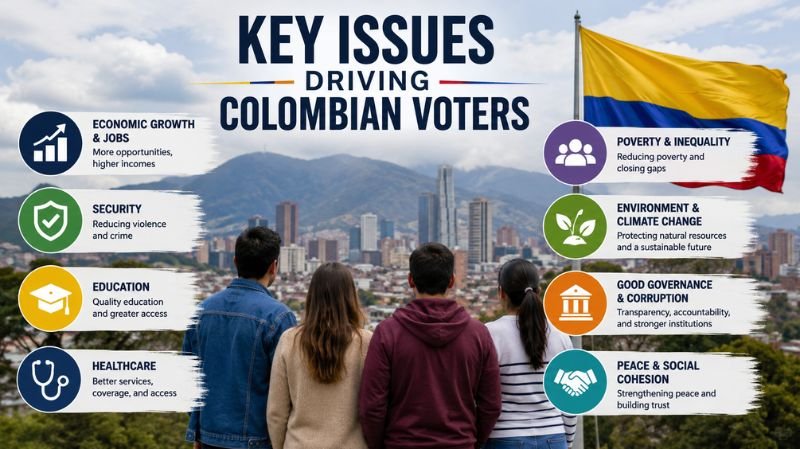
1. Security and Armed Groups
Despite the 2016 peace deal, violence has not ended. FARC dissidents who rejected the accord (known as disidencias), the ELN (National Liberation Army), and criminal organizations called BACRIM continue to operate in rural areas. The Petro government launched a ‘Total Peace’ (Paz Total) policy in 2022, attempting negotiations with all armed groups simultaneously — a strategy that has produced mixed results.
Security concerns rank among the top electoral issues for Colombians, particularly in departments like Cauca, Chocó, and Norte de Santander.
2. Economic Inequality
Colombia’s Gini coefficient (a measure of income inequality) stood at approximately 0.54 in 2023 — one of the highest in Latin America and globally. Nearly 33% of Colombians lived below the national poverty line as of 2022. Unemployment hovers around 10–11%, with underemployment and informal labor affecting up to 60% of the workforce. These realities make economic reform and social protection central electoral themes.
3. Corruption
Transparency International’s 2023 Corruption Perceptions Index ranked Colombia 83rd out of 180 countries. Major scandals — including the Odebrecht bribery case which implicated politicians across parties, and alleged vote-buying schemes known locally as mermelada politics — have fueled voter demand for anti-corruption candidates.
4. Environmental Policy and Fossil Fuels
Colombia is the world’s 5th largest coal exporter and a significant oil producer. President Petro’s pledge to halt new oil and gas exploration contracts has become one of the most polarizing electoral issues. Opponents warn of economic damage; supporters argue it is necessary for climate commitments and to protect the Amazon. Colombia contains approximately 10% of the world’s biodiversity and significant portions of the Amazon basin.
5. Education and Healthcare
Access to quality public higher education was a central demand of the 2019–2020 student protests that shook Colombia before the COVID-19 pandemic. Healthcare reform — particularly regarding the EPS (health promotion entities) system’s efficiency and equity — has been a priority under the Petro government, though proposed reforms stalled in Congress in 2023.
6. Drug Policy
Colombia remains the world’s largest coca leaf and cocaine producer. Electoral debates consistently revolve around whether to pursue eradication (including aerial fumigation with glyphosate), alternative development programs, or more radical decriminalization approaches. US-Colombia counter-narcotics cooperation is directly tied to whoever holds the presidency.
6. How Colombia Votes by Region
Colombia’s political geography is deeply fragmented. Understanding regional voting patterns is essential for analyzing electoral outcomes:
- Bogotá (D.C.): The capital and largest city (8+ million people) tends to support progressive and centrist candidates. It elected left-wing mayors in 2015 (Enrique Peñalosa) and 2019 (Claudia López). Petro dominated Bogotá in 2022.
- Antioquia and Medellín: Historically the heartland of Uribismo (supporters of Álvaro Uribe). Conservative and Democratic Center candidates consistently perform strongly here. Medellín, despite its transformation from drug war epicenter to urban innovation hub, maintains a conservative electoral tradition.
- Pacific Coast (Chocó, Valle del Cauca): Predominantly Afro-Colombian regions that voted heavily for Petro in 2022, driven by Francia Márquez’s appeal and longstanding demands for social investment in neglected communities.
- Caribbean Coast (Barranquilla, Cartagena, Córdoba): Traditionally controlled by regional political machines and clientelist networks. Electoral outcomes here often reflect local power brokers rather than national ideological trends.
- Llanos Orientales and Amazon: Sparsely populated but increasingly important due to oil revenues and deforestation debates. These regions are often affected by armed group activity.
- Coffee Region (Eje Cafetero): Traditional Conservative stronghold, though shifting younger demographics are introducing more competitive dynamics.
7. Electoral Challenges
Political Polarization
Colombia’s Elections political spectrum has grown increasingly polarized since the 2016 peace referendum, which divided the country nearly down the middle. The 2022 presidential campaign featured harsh rhetoric, with accusations of authoritarianism from the right and oligarchy from the left. Governing consensus has become difficult to build.
Violence Against Political Leaders
Colombia Elections remains dangerous for politicians and activists, particularly at the local level. According to Indepaz (Institute for Development and Peace Studies), over 180 social leaders and human rights defenders were killed in 2023 alone — though this figure was lower than the peak years of 2020–2021. Several mayoral and congressional candidates faced death threats during the 2023 local elections.
Misinformation and Digital Manipulation
The 2022 campaign saw coordinated disinformation campaigns on WhatsApp, TikTok, and Facebook, including false claims about Petro’s economic plans and fabricated videos. The National Electoral Council (CNE) and civil society organizations like Colombiacheck and La Silla Vacía played active fact-checking roles — but the speed of viral misinformation consistently outpaced corrections.
Vote-Buying and Clientelism
‘Mermelada politics’ — a colloquial term for the exchange of government contracts, public positions, or direct cash payments for political support — remains endemic in certain regions. The CNE has limited investigative powers, and prosecutions for electoral fraud are rare.
Abstentionism
Despite the 2022 surge to 58.1% turnout, approximately 42% of registered voters still did not participate. Structural barriers — geographic remoteness, lack of transportation to polling stations, distrust of institutions — contribute to persistent abstentionism, particularly in rural areas.
8. International Significance
US-Colombia Relations
Colombia Elections has received more than $11 billion in US aid since Plan Colombia launched in 2000, primarily for counter-narcotics and security cooperation. The Petro government has strained this relationship by criticizing US drug policy and opposing aerial fumigation. The Biden administration maintained diplomatic engagement despite tensions; the trajectory under future US administrations will be a key variable.
Venezuela and Regional Dynamics
Colombia Elections shares a 2,219-kilometer border with Venezuela. Under Petro, diplomatic relations with the Maduro government were restored after a four-year freeze — enabling economic cooperation and joint management of irregular migration (approximately 2.9 million Venezuelan migrants live in Colombia as of 2025). This policy shift remains controversial domestically.
Climate and Biodiversity
Colombia Elections ranks as the 2nd most biodiverse country on Earth (after Brazil) and contains approximately 10% of global species. Deforestation in the Colombian Elections Amazon accelerated during the COVID-19 pandemic. Electoral decisions about oil extraction, mining, and land use have direct implications for global climate commitments under the Paris Agreement.
9. The 2026 Elections: What to Expect
The next Colombian presidential and congressional elections are scheduled for May 2026, with a potential runoff in June 2026. Several dynamics will shape the campaign:
Petro’s Political Standing
As of mid-2025, Petro’s approval ratings have fallen from post-election highs. Key legislative reforms — including healthcare, labor, and pension reform — have faced significant opposition in Congress and from the business community. His ability to deliver on campaign promises will be central to the Historic Pact’s electoral viability.
Opposition Consolidation
The right and center-right remain fragmented between Democratic Center, the Conservative Party, and potential independent candidates. Whether these forces can coalesce around a single candidate — as they did to some extent behind Federico Gutiérrez in 2022 — will be decisive.
New Voices and Youth Mobilization
Colombia Elections has one of the youngest populations in Latin America, with a median age of approximately 31. Youth voter turnout increased substantially in 2022. Student movements, feminist collectives, and environmental groups remain politically active and could amplify emerging candidates.
The ELN Peace Process
Petro’s ongoing negotiations with the ELN guerrilla group represent a wildcard. A successful agreement could boost the Historic Pact’s standing. A breakdown — or a major escalation of violence — could benefit security-focused opposition candidates.
| Electoral Calendar: Congressional and first-round presidential elections: March 2026 (likely). Presidential second round (if needed): May/June 2026. Local elections: October 2027. |
10. Frequently Asked Questions (FAQ)
| Question | Answer |
| When is the next Colombian presidential election? | The next presidential election is scheduled for May 2026, with a potential second round in June 2026. |
| Who was Colombia’s first left-wing president? | Gustavo Petro, elected in June 2022, became Colombia’s first left-wing president. He won the runoff with 50.4% of the vote. |
| Does Colombia allow presidential re-election? | No. The Constitution of 1991 (amended in 2015) prohibits immediate consecutive presidential re-election. |
| What is the FARC peace deal? | The 2016 peace agreement between the Colombian government and the FARC guerrilla ended over 50 years of armed conflict. Former combatants were granted political participation rights. |
| How does Colombia’s two-round election work? | If no candidate wins more than 50% in the first round, the top two candidates compete in a second round (runoff) held three weeks later. |
| What is the voting age in Colombia? | Colombian Elections citizens can vote from age 18. Voting is voluntary — not compulsory — which explains historically modest turnout figures. |
Conclusion
Colombia’s Elections are a mirror of the country’s extraordinary complexity — a nation simultaneously processing the aftermath of decades of armed conflict, the demands of a young and increasingly connected citizenry, and the structural challenges of inequality, corruption, and environmental sustainability.
From the National Front’s enforced stability to the historic upset of 2022, Colombian democracy has proven remarkably resilient. The question heading into 2026 is whether the country’s institutions can sustain the weight of deep ideological divisions, deliver on the promises of the 1991 constitution, and navigate a world in which climate change, migration, and drug policy demand both national resolve and international cooperation.
For students, journalists, policy analysts, and global citizens alike, Colombia’s elections remain one of the most instructive examples of democracy in action — messy, contested, and vital.